-loading-to-ship-article_image.jpg&w=1920&q=75)
🚀 It’s Live: Meet StaalXneXt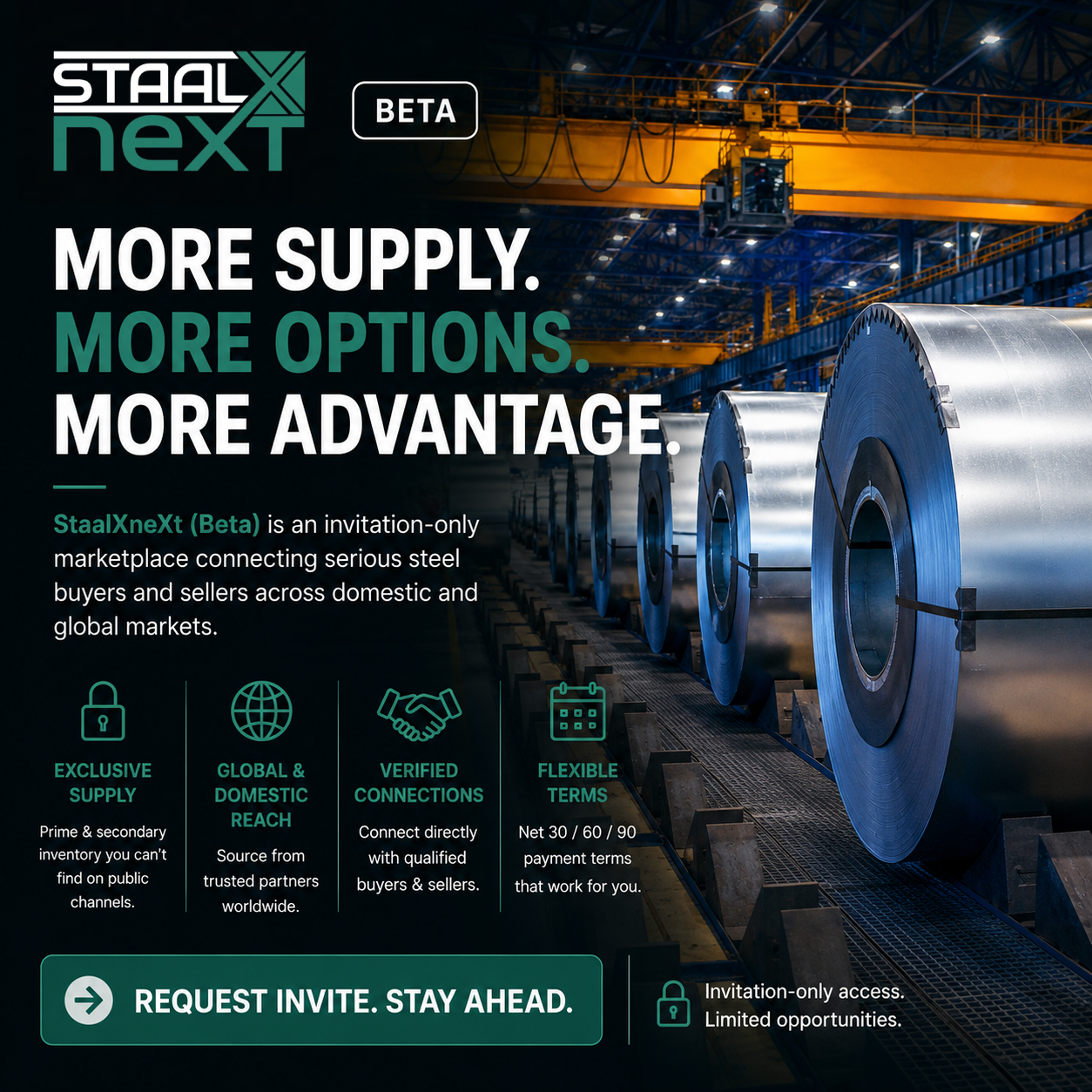 Check it out at www.next.staalx.com or contact us at support@staalx.com for more information. Updates From This Week Record-High Domestic Prices May Stick Around for a While It has been almost three months since hostilities began in the Persian Gulf. Since then, we have seen an immediate escalation in ocean freight rates, alongside price increases from traditional Asian and North African steel producers. Meanwhile, demand in Asia remains sluggish, and China continues to dominate regional markets with aggressively low-priced rebar and wire rod. When the conflict started, the closure of the Strait of Hormuz triggered all kinds of apocalyptic predictions, with economists anticipating a global crisis far exceeding the Covid-19 pandemic. Yet, other than injecting severe volatility into oil futures and bumping domestic gas prices up by about a dollar a gallon, the real macroeconomic impacts have been remarkably muted in the US. There is certainly no energy shortage, gas station lines are nonexistent, and we haven't seen a noticeable food price crisis. Inflation is threatening to rear its ugly head, but this is arguably a hangover from previous tariff policies rather than a direct result of the three-month-old war with Iran. Lately, the news cycle has been swinging wildly between hope and pessimism, with daily rumors regarding the reopening of the Strait to get oil flowing again. While traffic through the Strait of Hormuz has slowed to a crawl over the last three months, crude futures actually dipped below $100 a barrel this week. This raises an interesting question: Has the global market already adjusted to the supply chokeholds on oil and fertilizer by successfully sourcing alternatives elsewhere? When it comes to steel, import prices remain stubbornly elevated. Supported by aggressive Section 232 tariff policies, import costs are sitting incredibly close to domestic pricing. This has left buyers stranded on the fence, unsure of what is around the corner. With domestic steel prices hovering near all-time highs, this upcycle has lasted far longer than anyone anticipated—and the eventual downturn could be brutal. On the domestic front, we are seeing a continuous wave of price-increase announcements. The latest came via large structural channels, which slapped on a whopping $90 per short ton. This move is a clear shot across the bow, signaling that another large increase is likely brewing for the rest of heavy structurals and beams. Wire rod and rebar price hikes won't be too far behind. Looking ahead, we should expect a sharp dip in import arrivals starting in July and lasting through the next three months. If domestic demand keeps running hot, we could face critically low inventories for rebar and wire rod in the third and fourth quarters. The wire rod market is particularly vulnerable; domestic production consistently falls short of consumption, and the looming summer months traditionally bring operational and production challenges. Buyers are understandably terrified that any unplanned mill outage will completely decimate their remaining safety stocks. To make matters worse, buyers won't be able to look to Canada or Mexico to plug the holes when supply gaps appear. Both neighboring markets are effectively walled off from the US right now. Rather than dealing with complex US cross-border trade friction, mills in both nations have erected their own domestic safeguards. They are fully committed to supplying their own busy local markets, leaving little incentive to divert tons across the border. Weekly Poll With domestic prices near record highs and imports still expensive, what is your biggest concern right now? Last Week's Poll Result  From our content partner, SteelOrbis .jpeg) Domestic rebar and wire prices steady as Nucor ups specialty product prices Thursday, 28 May 2026 20:17:39 (GMT+3) San Diego Rebar and wire rod prices remained stable this holiday-shortened week as supply and demand appear to be balanced in continued thin trade, market insiders told SteelOrbis. This week’s continued stable pricing for standard long steel grades comes amid additional announcements from steel maker Nucor of additional price increases for its specialty products. This and other early-May mill price increases come at a time when US domestic steel producers remain squeezed by a continuation of low Section 232 tariff-inspired imports, even as insiders report improving long steel demand from data center and other government-related infrastructure construction activities. “Data center, infrastructure and energy-related construction continue to outperform traditional commercial construction, creating pockets of very strong demand, despite slower activity in some institutional and smaller commercial segments,” reported one US Gulf Coast-based long steel insider. “Overall sentiment across the industry is improving gradually, with buyers increasingly focused on securing reliable supply rather than aggressively challenging pricing.” The insider continued. “Import arrivals are expected to remain below historical levels due to tariffs, longer lead times, higher freight costs, and firmer offshore offers.” He added, “This dynamic continues to support domestic pricing stability across most long steel product categories.” In the domestic rebar market, Midwest rebar on an FOB mill basis remained steady for a second week at $47.00-48.00/cwt. ($940-960/nt or $1,036-1,058/mt), up from $46.00-47.00/cwt., ($920-940/nt or $1,014-1,036/mt) two weeks earlier. SteelOrbis data shows on a yearly basis, domestic rebar prices remain up about 24 percent from equivalent weekly levels seen one year ago. In the local wire rod markets, spot pricing on the US Gulf Coast remains steady following earlier $1.00/cwt., ($20/nt or $22/mt) price increases a month ago, bringing pricing on an FOB basis to $50.00-51.00/cwt., ($1,000-1,020/nt or $1,102-1,124/mt). Traders said again this week that ongoing market tightness for wire rod products could prompt US mills to seek further price increases for the grade, though some said an expected increase in import competition as domestic prices continue higher, could limit the amount of a potential increase, or its market acceptance once reported. One US East Coast rebar insider summed up the current domestic long steel market thus, favoring a humorous approach. “You have heard me say this before,” he said. “But, no matter what spin the steel industry, or the government, or the economists put on things, there is too much household consumer debt. It’s up $4 trillion since COVID. This is why each construction season for the last three years have been sluggish, and why it will continue until something gives.” He continued. “What does this mean for the market? On the US East Coast, more specifically, the Mid-Atlantic region, pricing is flexible. I think the mills are willing to give a little to secure orders. Not hot yoga flexible, but more like (Alexandra Ocasio Cortez) going to a country music festival flexible. Reluctant, hesitant, cautious, but still tapping her feet to the music.” Even as rebar and wire rod assessments were unchanged, on May 22, Huger, S.C--based Nucor Steel Berkeley, announced pricing for 12-inch and 15-inch channels would rise by $90 a ton ($4.50/cwt.) In addition, effective with new orders received on May 26, the mill will increase its grade adder for A65 to $100/ton or $5.00/cwt. The mill also announced its size adder for W6x7 would rise to $120/ton or $6.00/cwt. All confirmed orders as of the close of business May 26, will be price protected if shipped before June 12, the mill said in a customer letter. On the suppy side, according to the most recent data from the American Iron and Steel Institute (AISI), US steel mills produced 1,870,00 net tons of raw steel during the week ended May 23, at a capacity rate of 81 percent, off from the 1.898 million net tons of raw steel at a reported 82.2 percent of capacity during the week ended May 16, the highest since August 2024. And while off 1.5 percent on the week, current week production still represents an 8.7 percent increase from the same period in 2025. In other news, and as previously reported by SteelOrbis, US-based Nucor Corp. has officially opened its Lexington rebar micro mill in Lexington, North Carolina, bringing 430,000 tons of annual rebar capacity online to serve construction and infrastructure projects along the East Coast of the US. US import long steel prices stable on week as markets wait on latest peace deal with Iran Friday, 22 May 2026 19:21:53 (GMT+3) San Diego US import long steel prices were stable to week-ago levels, as global steel buyers remained cautious and mostly sidelined waiting on the results of the latest diplomatic talks aimed at securing a permanent ceasefire between the US and Iran, market insiders told SteelOrbis. On April 13, following six weeks of conflict, a temporary ceasefire was put in place, which later included a US-led blockade of the Strait of Hormuz, where 20-25 percent of global oil supplies flow. When oil prices spiked, and combined with sporadic Iranian attacks on shipping in the strait, many global shippers raised freight rates as much as 40 percent. In addition to rising freight and insurance costs, steel suppliers have since put in place fuel surcharges to offset rising energy prices, that also have contributed to increased global steel prices. For the moment, US President Trump has put on hold plans to resume military operations, giving peace talks “a few more days,” he said. Global oil prices remained elevated on May 22, with Brent crude oil traded between $104-$106 per barrel, following Trump’s mid-week warning that a military assault on Iran could happen “at a moment’s notice,” if an agreement isn’t reached soon. On the supply side, global steel importers told SteelOrbis this week that one of the effects of the ongoing hostilities with Iran is that fewer shipments of steel have been booked over the past several months, meaning that domestic supply could continue to tighten, even as imports remain sharply down as a result of ongoing 50 percent US import tariffs. “Since the beginning of the war in late February, new steel bookings have fallen off sharply, so supply could really tighten toward the end of Q3 and the beginning of Q4,” said one US Midwest-based long steel insider. “Lead times on new steel (orders) from South Korea to the US are now averaging about 4 months.” On the US Gulf Coast, import rebar on a loaded truck basis remained stable, following previous $0.50/cwt., oil-inspired weekly increases to $46.00-47.00/cwt., ($920-940/nt or $1,014-1,036/mt), up from $45.50-46.50/cwt., ($910-930/nt or $1,003-1,025/mt) two weeks earlier. US East Coast import rebar pricing on a loaded truck basis also remained steady at $46.50-47.50/cwt., ($930-950/nt or $1,025-1,047/mt), up from $46.00-47.00/cwt., ($920-940/nt or $1,014-1,036/mt) two weeks earlier as oil prices rose. On the domestic side, US long steel prices are expected to remain steady to up as a result of solid domestic demand from infrastructure builds and expectations for continued strong raw material scrap prices combined with more limited supply as imports remain reduced. This week, US mills reported steel production levels in excess of 82 percent capacity, the highest levels reported since mid-2021. “In the US, I still think there’s more gas in the tank,” the Midwest insider said in reaction to questions about domestic long steel price levels going forward. “We might continue to see additional mill price increases for both rebar and wire rod over the next 3-4 months.” He continued, “After that, the fear is that pricing could collapse like it did following a brief panic-driven price spike in global steel prices that happened as a result of the escalation of the Ukraine war in 2022.” On the steel import side, most recent import permit data from the American Iron and Steel Institute (AISI) finds that total import permits for April totaled 1,945,000 net tons (nt). This was an 8.1 percent increase from the 1,799,000 permit tons recorded in March and a 10 percent rise from the March final imports total of 1,769,000 nt. Import permit tonnage for finished steel in April was 1,417,000, up 8.5 percent from the final imports total of 1,306,000 in March. For the first four months of 2026 (including April SIMA permits and March final imports), total and finished steel imports were 7,044,000 nt and 5,157,000 nt, down 28.8 percent and 30 percent, respectively, from the same period in 2025. AISI said the estimated finished steel import market share in April was 17 percent and is 15 percent year-to-date. March market share rose 6.6 percent versus February, AISI said. USWC/USEC containerized ferrous scrap prices soften, USWC bulk scrap drops as well for the second week Wednesday, 27 May 2026 22:33:11 (GMT+3) San Diego Prices for containerized ferrous scrap at the US West Coast (USWC) docks softened on the lower end of their ranges this week as East Asian scrap demand has become more uncertain. In the USWC, the price of containerized HMS I/II 80:20 fell by $7/mt to $345/mt FAS Long Beach port, as this week, no deals could be confirmed at the previous $352/mt FAS level, while most reported seeing transactions at $345/mt FAS. Shredded softened to $365-370/mt FAS port, while containerized #1 busheling is reported down by $5/mt to $370/mt FAS port. San Francisco Bay Area prices sit $5/mt below Southern Californian prices. Vietnamese demand remains solid, and USWC participants have reported Vietnamese buyers in the market seeking US-origin HMS I/II 80:20 and #1 busheling material. Some of the Asian scrap demand seems to have become shaky in the past few days. In India, SteelOrbis reported that scrap purchasing has stalled as secondary mills have been submitting very low bids due to lower finished steel prices for the domestic market. Last week, Taiwanese demand for imported scrap was relatively stable, although Japanese sellers returned to the market, adding more material for the US to compete with. Ocean freight rates for containers are reported from the USWC at $15/mt CFR Taiwan. For bulk material, this week the higher rates are reported to be at the $80-85/mt CFR Bangladesh level. Some participants in the USWC have bemoaned the significant increase in the cost of doing business. In February, the ocean freight rate for bulk scrap from the USWC was $64/mt CFR Bangladesh. US East Coast (USEC) containerized prices have softened for a second week, as they appear to be affected by the bearish trend in bulk scrap that has developed over the past week. Bulk scrap exporters in USEC lowered their prices by $10/gt this week due to a weaker export market to Turkey. USEC containerized prices for HMS I/II 80:20 fell slightly in the lower-end range to $330/mt FAS New York (NY) port from $330-335/mt FAS last week, and shredded also softened to $355/mt FAS from $355-360/mt FAS last week. Bulk scrap For a second week, prices for bulk scrap in USWC contracted. Last week, they fell by $15/gt; this week, by $10/gt, as price announcements were made yesterday by some exporters. The price of HMS I to LA docks was reported at $250-260/gt delivered export yard, P&S 5ft fell by the same amount to $270/gt delivered, and shredder feed also fell $10/gt to $205-215/gt delivered. Prices for bulk scrap in the San Francisco Bay Area decreased by the same margin to $245-255/gt delivered export yard for HMS I, to $260/gt delivered for P&S 5ft, and to $200-210/gt delivered for shredder feed. Houston contacts again reported no change and retained $335/gt delivered export yard for HMS I, $350/gt delivered for P&S 5ft, and $310-320/gt delivered for shredder feed. Do you have any questions? Check out our FAQ!Check out the most frequently asked questions about the service and products of StaalX. We are always here to chat with you in the chat boxes from the site or on the support telephone number below. Contact us websupport@staalx.com or +1 (708) 697-3227 Follow StaalX on |







Need steel? Get an instant quote & save $500 off your first order
Search rebar, wire rod, wire mesh and more on StaalX. Check availability and book reliable delivery nationwide.
For sponsorship opportunities or advertising on StaalX News, contact us at websupport@staalx.com.