🚀 It’s Live: Meet StaalXneXt (Beta)StaalXneXt Beta is now live — an invitation-only marketplace built for serious buyers and sellers. Access exclusive supply, unlock hidden inventory, and connect with trusted partners across domestic and global markets. From spot opportunities to future orders — with flexible Net 30 / 60 / 90 payment terms — StaalXneXt gives you the control the traditional market never did.  Explore the upgrades at www.staalx.com or get in touch today with websupport@staalx.com to see the difference. Updates From This Week How Long Can Domestic Pricing Hold?In the US long products market, beams remain the standout performer, followed closely by wire rod. While merchant bars and rebar have shown some relative softness, mill order books remain healthy and busy. Rebar: The Hybar Factor and Import ReliefRebar pricing has softened recently as more tonnage hits the market. Much of this downward pressure is attributed to Hybar, the Arkansas-based newcomer that began production last year. Hybar continues to "elbow" into the crowded market by aggressively quoting lower numbers to build its customer base. Simultaneously, large shipments from South Korea have finally landed, providing much-needed relief for inventories that had reached critical lows. Interestingly, despite this localized softness, domestic mills successfully "tidied up" their sagging West Coast pricing, bringing it into parity with East Coast levels. Wire Rod: Supply Constraints and Tariff WallsOn the rod side, the story is one of scarcity. Even without new official price hikes, transactions have climbed another couple of notches and are now firmly above $50/cwt. Domestic capacity remains a bottleneck; several older mills are prone to outages, and despite government protection, many struggle to fund the upgrades necessary to stabilize production. The import market offers little sanctuary. While scrap pricing is holding relatively stable for May, pressure is mounting because no major offshore bookings have been made since the conflict in the Middle East escalated two months ago. The Logistics SqueezeImported rod is now priced nearly at parity with domestic levels. This is driven by a "perfect storm" of costs:
The OutlookRod buyers should secure whatever inventory they can find over the next six months. With deliveries delayed and the freight market in flux, prices are very likely to keep climbing. For the US long products market, 2026 is shaping up to be one of the most volatile years on record.Weekly Poll Which side worries buyers more today? Last Week's Poll Result   🎧 Missed Episode 22? Catch up now — we break down the growing collision between America’s megaproject boom and tightening steel supply. From soaring data center demand and wire rod shortages to oil-driven freight costs and trade barriers, this episode explains why contractors may be heading into a brutal summer squeeze. Listen now on ▶️ YouTube | 🎵 Spotify | 🎙 Apple Podcasts 👉 Follow the StaalX Construction & Steel Podcast for weekly insights on market shifts, freight trends, and sourcing strategies. 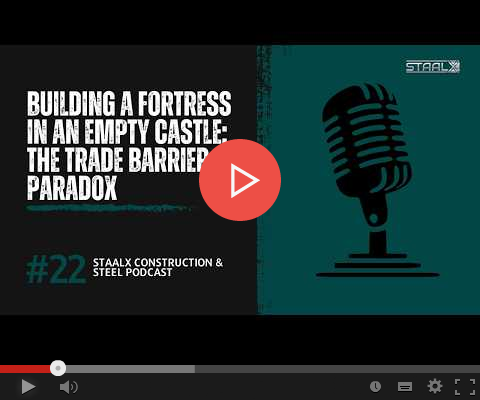 From our content partner, SteelOrbis .jpeg) US long steel prices finish steady as higher supply appears balanced by spring maintenance Thursday, 23 April 2026 20:29:08 (GMT+3) San Diego US domestic rebar and wire rod prices were steady this week, following a steady to lower assessment one week earlier, as increased output from new productive capacity appears to have been offset by lower short-term output from US bar mills conducting March-April spring maintenance operations, market insiders told SteelOrbis. While short-term supply and demand appear to be fairly well balanced this week, insiders caution that weekly spot markets still remain fairly tight overall, owing to continued 50 percent steel imports tariffs enacted by US president Trump on June 4, 2025. As a result of low imports -recently estimated in Jan-Feb down by 38 percent versus year-ago levels- and steady to growing demand for finished steel as the spring construction season gets underway, US steel plants reported crossing the 80 percent installed capacity level for the first time since August 2024. On the supply side, industry reports made available to SteelOrbis indicate a minimum of 28 days of combined rebar and wire rod production are scheduled to be offline for March-April maintenance operations. Market reports of two mills down for maintenance in Texas “simultaneously” were found to be inaccurate. Only Commercial Metal's Company's (CMC) 943,000 per year Seguin mini-mill was fully expected to be offline for maintenance for seven days in April. In the domestic rebar market, Midwest rebar on an FOB mill basis sold on average $46.00-47.00/cwt., ($920-940/nt or $1,014-1,036/mt) stable to week-ago levels, though still off $0.50/cwt., from two weeks earlier, when reports of boosted output from Nucor, Lexington, as well as Hybar Steel in Arkansas made local supply more plentiful. In the absence of local industry news, rebar insiders told SteelOrbis the big story this week was mill price increases on the US West Coast. Reports indicate that Nucor and CMC increased local rebar prices by $50/nt ($55/mt), to $46.00-47.00/nt ($980-1,000/nt of $1,080-1,102/mt), bringing local West Coast rebar price levels on par with local pricing at the US Gulf Coast. “Recently we saw the West Coast rebar markets priced cheaper than Texas,” quipped one Midwest rebar insider. “Now, Nucor and CMC have straightened that situation out by raising their local prices there.” “The big story this week was rebar pricing up $50 per ton on the US West Coast,” said one Midwest long steel trader. “Nucor started the price increase and then CMC followed.” In addition to the West Coast rebar price increases this week, insiders reported local $60/nt price increases for engineered SBQ steel by Nucor, Gerdau Steel, and Charter Steel, though no new price increase announcements could be found on steel company websites. In the domestic wire rod markets, insiders told SteelOrbis prices remained stable for a sixth week at $49.00-50.00/cwt., ($980-1,000/nt or $1,080-1,102/mt), though reports of “supply tightness” persist as supply from Peoria, Illinois-based Liberty Steel’s 700,000-ton wire and rod plant appears to remain somewhat limited, they said. US import long steel prices continue up amid higher freight, fuel charges, shipping concerns Thursday, 23 April 2026 19:52:08 (GMT+3) San Diego US import long steel prices continued to advance this week in response to reports of rising fuel and freight surcharges and more limited shipping availability as the global freight and shipping markets remain in flux as a result of the continuing volatile situation in the Strait of Hormuz, market insiders told SteelOrbis. And, while global oil prices have declined off recent highs following recent actions by the US Trump administration to ease geopolitical tensions with Iran, Trumps April 21 announcement of another 10-day ceasefire extension, even as a continued naval blockade exists in the Strait of Hormuz, does little to indicate how soon potential hostilities could or will end. At current, West Texas Intermediate crude oil -the US benchmark oil grade-trades at about $94.50 per barrel (/bbl), up from $85-88/bbl one week earlier, though still up more than 41 percent since hostilities with Iran began on Feb 28. Market insiders said on average, global shippers are adding $0.25-0.50/cwt., ($5-10/nt or $5-10/mt) to current delivered steel prices as a result of the more risky and expensive ongoing freight situation. “Some market players without access to reserves like Bangladesh are starting to run out of oil,” commented one US Gulf Coast steel importer. “Also, some vessel owners are starting to “re-neg” on contracts by declaring Force Majeure on existing shipments on the books, so available shipping capacity is getting even more restrictive.” He continued. “Rising oil prices is one thing, but, finding available freight right now is another and bigger concern.” On the US Gulf Coast, import rebar on a loaded truck basis is priced at $45.50-46.50/cwt., ($910-930/nt or $1,003-1,025/mt), up from $45.00-46.00/cwt., ($900-920/nt or $992-$1,014/mt) one week earlier. US East Coast import rebar pricing on a loaded truck basis also rose another $0.50/cwt., this week to on average $46.00-47.00/cwt., ($920-940/nt or $1,014-1,036/mt), up from $45.50-46.50/cwt., ($910-930/nt or $1,003-1,025/mt), one week ago. Most recent import data from the American Iron and Steel Institute (AISI) indicates that total import permits for March rose 6.6 percent versus those posted for February. And, although there is a growing likelihood for more imports later in Q2, actual imports for Jan-Feb 2026 period remain nearly 38 percent lower than one year prior, AISI said. Sharp declines in US imports as a result of ongoing steel tariffs has caused US mills to increase productive capacity to about 80 percent of capacity of late, insiders said, the highest level since August 2024. “Import prices of steel are still going up,” added another US Gulf Coast insider. “Higher ocean freight rates is resulting in a significantly higher cost to bring steel shipments into the US.” He continued. “Surcharges are really starting to add up,” he added. “The situation in the Middle East is inflationary to all commodities, and will eventually trickle down in the way of lower growth for the US economy.” Prices rose sharply this week as a result of heightened shipping costs for import rebar on a CFR “free out” basis on the US Gulf Coast. Average prices rose $20/nt ($22/mt) to $640-650/mt, not inclusive of ongoing US 50 percent import tariffs. In the import wire rod markets, wire rod mesh on a DDP loaded truck basis US Gulf Coast, is discussed at $47.50-48.50/cwt., ($950- 970/nt or $1,047-1,069/mt), up from $47.00-48.00/cwt., ($940-960/nt or $1,036-1,058/mt), one week prior. “Free out” pricing for import wire rod rose even more than those seen for import rebar, showing a $40/mt increase on the week to $670-680/mt, global importers told SteelOrbis. On the domestic long steel side, increased output from two key US mills, Nucor, Lexington, Ky., and Hybar Steel, in Arkansas, continues to prevent US rebar prices from rising to the point where import material has much room to compete. This week, domestic rebar pricing was steady to week-ago levels at $46.00-47.00/cwt., ($920-940/nt or $1,014-1,036/mt) on an FOB mill basis, following a $0.50/cwt., decrease reported a week earlier. Domestic wire rod mesh on a US Midwest ex-mill basis remained flat for yet another week at $49.00-50/cwt., ($980-1,000/nt or $1,080-1,102/mt) as available spot supplies are reported more limited than those for rebar, insiders said. US domestic ferrous sentiment improves ahead of May trading cycle Thursday, 23 April 2026 20:34:23 (GMT+3) San Diego Participants in the US domestic ferrous scrap trade have raised expectations for May, with the outlook shifting to a strong sideways trend. Several factors influencing the US scrap market have continued to improve in recent days, fueling bullish sentiment. At worst, many expect no movement in May, while a downturn in any grade does not seem to be considered. Specifically, some think a $10/gt ($9.8/mt) increase in cut and prime grades is possible. Some buyers have started inquiring about prime grades this week. The factors Among the positive factors is the current spread that exists between finished steel and scrap prices. In the US Midwest, the price for hot-rolled coil (HRC) sits at $1,050-1,055/nt ($1,157-1,163/mt) ex-US mill with a potential to go up even further before the week is over, and #1 busheling is valued at $450/gt ($443/mt) delivered consumer. This represents an approximate spread of $700/mt, whereas the usual spread has been closer to $400/mt, prompting participants to comment that scrap is undervalued. The price of hot-rolled plate (HRP) has also been rising by $90-120/nt ($99-132/mt) over the past few weeks. May trading is still at least ten days away, expected to begin on May 4 at the earliest, but recent bullishness is coalescing around other factors, such as the positive trend in US basic pig iron (BPI) over the past three months. The price of high-phosphorous material has grown by $20/mt in each of the last two months. In mid-February, the price stood at $460/mt CFR New Orleans (NOLA); by mid-March, it had climbed to $480/mt CFR; and currently, in mid-April, it sits at $500-505/mt CFR. This is another significant boost for US scrap prime grades. For their part, Brazilian producers have been finding bullishness in their market from strong finished-steel prices and robust BPI demand. It should be noted that this year they opened a new trade route to Italy, broadening their commercial options. SteelOrbis has also reported brisk activity in the export market, both from the US East Coast (USEC) and the US West Coast (USWC). Export activity to Turkey picked up this week as the price of US-origin HMS I/II 80:20 improved by $4.5/mt this week to $404.5/mt CFR Turkey. Import prices to Bangladesh for bulk scrap also rose this week, even if import prices for containerized scrap have decelerated. Yet prices to the docks have not improved during this time, with uncertainty in global freight and energy prices preventing exporters from increasing their costs of inflows. The price of HMS I to New York and Philadelphia docks has remained at the $280-290/gt ($276-285/mt) delivered export yard for some weeks now. In that regard, domestic consumers should not be too worried about competition from the export market; on the contrary, contacts have mentioned exporters need to improve their prices (some have ventured to say by $40-45/mt) to compete with the domestic market. Lastly, the US steel sector’s installed capacity utilization rate finally broke the 80 percent threshold, and there it sits for the last reported week , according to the American Iron and Steel Institute (AISI), a level not seen since Aug 2024. This also has contacts indicating a significant scrap appetite among US mills. On the downside, some mills and sellers report that abundant shredded material is available in the US. The grade’s price contracted by $20/gt ($18.6/mt) delivered mill to $430/gt ($423/mt) delivered in March. And that, overall, scrap flows are good due to the improved Spring weather. The strong sideways outlook will be revised over the next two weeks, prior to May trading. Do you have any questions? Check out our FAQ!Check out the most frequently asked questions about the service and products of StaalX. We are always here to chat with you in the chat boxes from the site or on the support telephone number below. Contact us websupport@staalx.com or +1 (708) 697-3227 Follow StaalX on |







Need steel? Get an instant quote & save $500 off your first order
Search rebar, wire rod, wire mesh and more on StaalX. Check availability and book reliable delivery nationwide.
For sponsorship opportunities or advertising on StaalX News, contact us at websupport@staalx.com.