-article_image.jpg&w=1920&q=75)
 Check it out at www.next.staalx.com or contact us at support@staalx.com for more information. Updates From This Week Buyers Push Back on Further Hikes as the Summer Slowdown ArrivesAs we cross into mid-June, the US steel long products market is experiencing a bit of a seasonal identity crisis. On one hand, we have mills testing the waters with price hikes; on the other, a classic summer slowdown is creeping in, giving buyers the leverage they need to say "enough is enough." Here is how the landscape is shaping up across supply, demand, and imports this week. The domestic mill scene is currently a tale of two products. While some sectors are holding firm, others are hitting a clear ceiling. Beams: Last week’s major headline was Nucor’s $50/short ton price increase on structural beams. This move caught some by surprise given the broader macroeconomic headwinds, but it underscores the mills' desire to protect margins ahead of the slower summer months. We are monitoring how well this increase sticks as service centers assess their current inventories. Rebar: The domestic rebar market appears to have found its temporary baseline. Following the last round of mill price increases, the market has settled into an equilibrium. Buyers are actively resisting any further price hikes, dug into their positions, and feeling confident that current supply levels don't justify paying a premium. Wire Rod: Tightness remains the defining characteristic for wire rod, but it is not triggering panic buttons just yet. Domestic mills are doing a commendable job managing the demand, ensuring regular customers get their allocations. There is no real shortage to speak of, just a very tightly balanced market. Scrap and Import Dynamics: Softening on the Horizon? Keep a close eye on the Midwest and Chicago Shredded scrap indicators as we move through June. With overall steel demand showing signs of a summer cooldown, raw material prices are expected to face some downward pressure. If scrap softens in the coming weeks, domestic mills will have a much harder time defending recent long product price increases. On the trade front, we are noticing the first ripples of change from overseas: Import Note: Asian steel prices have started to soften, reflecting weaker domestic demand in their home markets. However, this hasn't translated to cheaper landed steel for US buyers just yet. Import offers to the US remain relatively unchanged, though we expect traders to start dangling lower numbers if the domestic spread continues to widen. Consumption Factors: The Data Center Roadblock For the past few quarters, steel producers have been happily riding the wave of the artificial intelligence and cloud computing boom. Data center construction has been a massive, reliable engine for structural steel and rebar demand. However, that engine is sputtering a bit. Projects are increasingly running into public pushback over immense energy grid consumption, water usage, and zoning issues. These community hurdles are causing noticeable project delays. For a steel market that was heavily relying on this sector to offset quieter commercial and residential construction, these delays mean a chunk of anticipated summer demand is being pushed into late fall or next year. Combined with the usual seasonal deceleration as construction crews navigate summer heat and vacation schedules, overall steel demand is cooler than it was a month ago. We are entering a classic summer chess match. Nucor is drawing a line in the sand with beams, but with rebar at equilibrium, wire rod managed, and data center projects hitting regulatory red tape, the upside for domestic prices feels limited. Expect a quiet, watchful period over the next few weeks as the market digests the recent beam hike and waits to see if Asian import offers drop enough to force domestic mills' hands. Weekly Poll Which side wins the summer chess match? Last Week's Poll Result 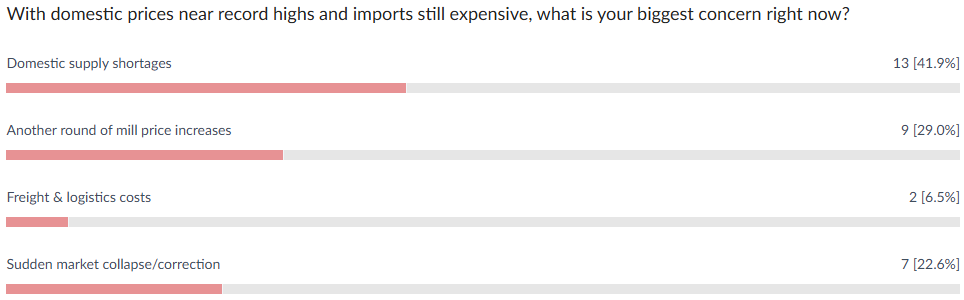 From our content partner, SteelOrbis .jpeg) US domestic rebar and wire rod flat as mills keep steady pricing to discourage imports Thursday, 11 June 2026 18:37:35 (GMT+3) San Diego Rebar and wire rod markets continued steady this week, as US mills appear to be keeping spot pricing stable to fend off the encroachment of long steel imports, market insiders told SteelOrbis. Despite recent price increases from US mills for their specialty long steel products, traders said domestic supply and demand appear to be fairly well balanced as markets head into the first half of June. Currently, finished steel prices continue well supported by reduced import competition for market share as a result of ongoing Section 232 steel tariffs, higher energy pricing from recent heightened conflict in the Middle East, as well as improved domestic demand from data center builds and other infrastructure-related long steel buying activities. In the domestic rebar market, Midwest rebar on an FOB mill basis remained steady for a fourth week at $47.00-48.00/cwt. ($940-960/nt or $1,036-1,058/mt), though up from $46.00-47.00/cwt., ($920-940/nt or $1,014-1,036/mt) earlier. SteelOrbis data shows on a yearly basis, domestic rebar prices remain about 24 percent higher on an equivalent weekly basis. In the local wire rod markets, spot pricing on the US Gulf Coast remained stable on an FOB mill basis at $50.00-51.00/cwt., ($1,000-1,020/nt or $1,102-1,124/mt). And, while US long steel pricing is expected to remain fairly static near term, recent actions by the US Trade Representative (USTR) concerning Brazilian pig iron tariffs could cause further market disruptions, insiders said, with a potential move higher in finished steel prices possible, insiders said. As previously reported by SteelOrbis, Brazilian pig iron, included in the list of exemptions from the US import tariffs in November 2025, was not included in a new list, announced by the USTR on June 1. With the exclusion as it now stands, Brazilian pig iron could be the subject of 25 percent import tariffs in the US, raising concerns by the federation of the industries of the state of Minas Gerais (Fiemg) about the future of the sector. Contacts in Brazil told SteelOrbis this week that negotiations continue, but they believe that the necessary inclusion in the list of exceptions to tariffs will be achieved by “domestic pressure in the US,” as they “depend on the Brazilian pig iron, not only due to competitive price, but also due to the fact that the Brazilian product is made with charcoal, used as reductant, this resulting in close to zero C02 emissions,” they said. In a statement, Fiemg added that the potential 25 percent import tariff has created uncertainty for local producers, especially in Sete Lagoas, the state’s main pig iron exporting city, where 85 percent of production is shipped to the US, mostly for use my domestic mills as a replacement for ferrous scrap in steel production. According to the foreign trade secretariat of the ministry of development, industry and foreign trade (Secex), in 2025 the state of Minas Gerais exported 2.47 million metric tons (mt) of pig iron to the US, worth $1.01 billion. During the first four months of 2026, the numbers were 644,700 mt, worth $258 million. Regardless of the developing pig iron situation, US markets remain on edge, despite a continuation of stable pricing. “Current rebar pricing remains steady...not up...not down,” said one US Northeast long steel insider about the current week’s spot market action. “Rebar availability is going to (remain) spotty and we are anticipating mill allocations in the fall,” he added. “Prices are too high to speculate and buy ahead of time, so, if domestic pricing continues higher, imports will increase in quantity.” Traders are also eyeing recent developments with regard to a May 29 announcement from USTR representative Jamieson Greer about a sweeping Section 301 investigation focusing on structural excess capacity and production in manufacturing sectors globally, which broadly includes Vietnamese steel products including the all-important import wire rod sector, where Vietnam recently has been increasingly active on the supply side. US import long steel prices steady in light trade amid new Iran actions Friday, 12 June 2026 19:00:19 (GMT+3) San Diego US import long steel prices remained stable in light weekly trade this week as focus once again shifted to renewed military strikes by the US military in the Middle East, and a potential new peace deal, market insiders told SteelOrbis. On June 11, following several days of intensified US moves against Iranian targets, media reports indicated that US President Trump announced intentions to take control of Kharg Island, a key oil and gas infrastructure asset currently controlled by Iran. After initially calling for more intensified strikes, Trump later reversed plans to launch strikes late on June 11 after reports indicated a memorandum of understanding would be signed as soon as this weekend with Iran, potentially ending the conflict and opening the Strait of Hormuz, where 20 percent of world oil flows. Oil prices dropped more than $3 per barrel on the news, while the US stock market surged more than 1,000 points. “I would say import long steel pricing has been pretty flat, with less of a potential for an uptrend I am seeing,” said one US Midwest long steel insider. “Things are maybe cooling off a little in the situation with Iran.” In the import wire rod mesh market, pricing for DDP loaded truck material vicinity Houston remained flat following this past week’s $0.50/cwt., move higher to $47.50-50.00/cwt., ($950-980/nt or $1,047-1,080/mt). Weekly pricing remained steady for still another week in the import rebar market owing to low import competition, the result of continued 50 percent import tariffs and plentiful domestic supply availability, insiders said. US Gulf Coast import rebar on a loaded truck basis remains steady at $46.00-47.00/cwt., ($920-940/nt or $1,014-1,036/mt), up from $45.50-46.50/cwt., ($910-930/nt or $1,003-1,025/mt) several weeks earlier. US East Coast import rebar pricing on a loaded truck basis also remained stable for yet another week at $46.50-47.50/cwt., ($930-950/nt or $1,025-1,047/mt), though up from $46.00-47.00/cwt., ($920-940/nt or $1,014-1,036/mt) one month earlier, as oil prices surged in reaction to supply-related jitters in the Middle East. High oil prices and elevated insurance risks have cause many steel suppliers, both domestic and import, to raise finished steel prices to cover additional fixed costs, estimated by some as high as 40 percent higher than before hostilities with Iran began in late February. Insiders also are keeping an eye on a potential new round of global Section 301 investigations that could result in additional tariffs and possible duties and quotas for Vietnamese wire rod as well as other global steel imports bound for the US. The outcome of the new Section 301 investigations announced by US Trade Representative Jamieson Greer on May 29 is important because the US is one of the top five importers of wire rod and related long products from Vietnam at current, especially following the June 2025 doubling of steel import tariffs on Canada and Mexico to 50 percent. In the US domestic long steel market, pricing remained steady for another week, with domestic rebar assessed unchanged at $47.00-48.00/cwt., ($940-960/nt or $1,036-1,058/mt), as insiders said US mills remain reluctant to raise prices for fear that additional price increases would encourage a surge in steel imports, undercutting current US mills' domestic market share, where many now operate in excess of 80 percent of capacity. US domestic ferrous scrap prices sideways across the board in June, primes could see uptick in July Thursday, 11 June 2026 05:39:46 (GMT+3) San Diego Scrap prices for the US domestic market trended sideways in June for all grades as scrap demand remains consistent and flows are adequate. Some buyers commented that there is an overabundance of scrap material in the market, but the steel sector’s robust activity has consumed it at a brisk pace. Contacts expect July to feature a similar trend, as part of the two to four months of stability projected in April. Yet there are market fundamentals and possible federal commercial policy implementations that could help prime grades’ prices in the summer months. In the meantime, #1 busheling settled at $450-470/gt delivered consumer in the Midwest, with Chicago remaining at $450/gt delivered, while in Detroit, mills were seen purchasing the grade in the $460-465/gt delivered range. Higher values for the grade were seen as well in Pittsburgh at $465/gt delivered and in Cleveland at $470/gt delivered. In the US East Coast (USEC), particularly in the domestic Philadelphia market, the grade remained flat at $450/gt delivered. Participants noted that most, some said all, of the available prime grades in the US were purchased in June, which could lead to limited supplies in July. Moreover, demand remains robust across the country. The installed capacity utilization rate has strung six weeks in a row above 80 percent (81.3 percent for last week), according to the American Iron and Steel Institute (AISI). The rate has not dropped from 79 percent in ten weeks. The price of hot-rolled coil (HRC) in the Midwest continues to grow, reaching this week $1,106.7/nt from $1,068/nt one month ago. During Steel Dynamics Inc.’s (SDI) Q1 call, Mark Millet, chief executive officer (CEO), mentioned that market fundamentals are in place for a robust steel consumption rate in the US, not only for the rest of 2026 but for years to come. He mentioned that order entry activity and higher prices continue to improve. Participants in the sector, in general, have mentioned that the 25 percent import tariffs the US imposed in March of last year have prevented high amounts of Asian finished steel from entering the domestic market. Executives in the sector, like Millet, have mentioned that the country’s manufacturing activity has recently expanded, providing additional opportunities for the steel sector. According to the US Bureau of Labor Statistics, total output from the country’s manufacturing sector increased annually by 3.3 percent in Q1. The Institute for Supply Management (ISM) reported a purchasing management index (PMI) for the manufacturing sector in May at 54 percent, indicating growth. The PMI for May is the highest since May 2022. ISM reported that the economy grew for the 19th month in a row. It also mentioned in its latest report that steel prices grew and that steel products remain in short supply. A recent development could help bolster prices for prime grades even more. The US Trade Representative left Brazilian pig iron out of the list of exclusions that avoid an import tariff into the US, possibly setting up a 25 percent duty for that material. As of Thursday, negotiations are ongoing between Brazilian officials, US authorities, and US manufacturers to determine if the duties could be removed. If a compromise is not reached, US mills that depend on Brazilian pig iron could turn to prime grades instead, lifting the price very soon. Balance in cut grades Cut grades remained sideways everywhere in June as well. In Houston, the price of HMS I remained unchanged at $350/gt delivered consumer, and P&S 5ft was also flat at $360/gt delivered. In Detroit, the price of HMS I was sideways in June, settling at $375/gt delivered, while P&S 5ft settled at $400/gt delivered. The export market, on both coasts, has been exerting downward pressure on cuts. Prices to USWC docks have decreased by $25/gt in the past few weeks, while in the USEC, they have also been softening lately. At the same time, the hot Summer weather could curtail scrap generation in some regions, particularly in the South. Do you have any questions? Check out our FAQ!Check out the most frequently asked questions about the service and products of StaalX. We are always here to chat with you in the chat boxes from the site or on the support telephone number below. Contact us websupport@staalx.com or +1 (708) 697-3227 Follow StaalX on |








Need rebar? Get an instant quote & save $500 off your first order
Check in-stock rebar inventory on StaalX Now for fast US delivery or pickup, or browse offers from verified sellers on StaalXneXt.
For sponsorship opportunities or advertising on StaalX News, contact us at websupport@staalx.com.