-article_image.jpg&w=1920&q=75)
 Check it out at next.staalx.com or contact us at websupport@staalx.com for more information. Updates From This Week Enjoy the Stable Market While It LastsThe steel long products market has officially entered its typical mid-summer slowdown. With fabricators, service centers, and mill reps out on well-deserved summer breaks, spot activity for rebar, wire rod, merchant bars, and structural beams has shifted into a lower gear. However, beneath the sleepy seasonal surface, macro wildcards are brewing trouble that one should still watch. The biggest shadow over global markets remains the Middle East. The flaring Iran conflict may serve as the ultimate wildcard for the markets. We already saw how intense escalations earlier this year choked key energy corridors, sent Brent crude spiking past $120 a barrel, and upended global logistics. Any renewed friction threatens to spark another wave of supply chain volatility just as things were starting to settle down. Demand: Riding a Single, Strained PonyLet’s talk about domestic consumption. On paper, US demand for long products remains respectable, but let's be honest: it is riding on a single pony right now, and that pony is Data Center Construction. Structural steel and rebar are being devoured by massive AI infrastructure projects across the country. But there’s a major catch. That pony is starting to look a bit winded due to massive community pushback. Local anxieties over power grid strain, water usage, and land zoning have officially moved from minor zoning hearings into state legislatures. Market Data Check: In the early months of 2026, community and local opposition successfully blocked or delayed 75 major data center projects—representing a staggering $130 billion in planned construction. With states introducing moratorium proposals, this critical demand driver for long products is hitting unexpected speed bumps, leaving the broader commercial construction sector looking for its next big catalyst. Supply & Trade: The Korean Rebar InfluxOn the domestic supply side, major mills like Nucor and Commercial Metals Company (CMC) remain well-insulated from foreign price undercutting thanks to robust tariff protections. Therefore, domestic producers aren't particularly worried about the price of imports—they are heavily focused on the volume making its way to shore. Specifically, a significant influx of South Korean rebar has made its way into the US market over recent months. This volume surge has visibly agitated domestic mills. In response to the friction and tightening trade scrutiny, several prominent South Korean mills have completely pulled their offers from the US market and the remaining ones have elevated their pricing to avoid entering a dumping investigation. Otherwise, softer pricing across Asian markets due to a widespread lack of regional demand means plenty of foreign steel is looking for a home, but 50% tariff and flat US domestic pricing are keeping most import sources out. On the raw materials front, for July, the Midwest and Chicago shredded scrap market is looking pretty much flat to slightly down. While the tight availability of prime scrap is keeping an absolute floor under prices, the seasonal summer slowdown has sapped any real upward momentum. Don't expect scrap to drive major mill price announcements in the immediate weeks. The real headache for logistics managers remains the cost of moving material:
StaalX Bottom LineEnjoy the quiet summer days while they last. With scrap trading sideways and data centers facing localized gridlock, finished long product prices should hold relatively flat in the near term. But keep your eyes on the volume charts—and the geopolitical headlines—because this market can turn around on a dime.Weekly Poll Which is the bigger risk to the steel market right now? Last Week's Poll Result 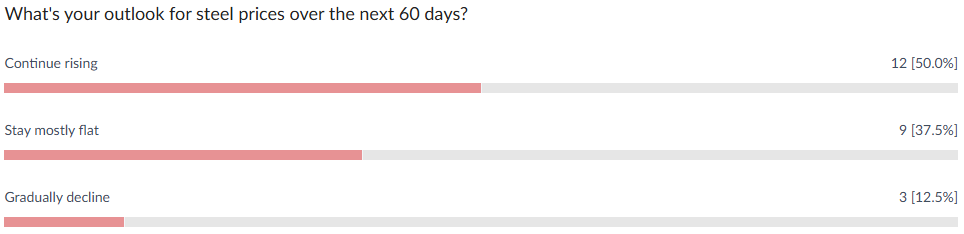 From our content partner, SteelOrbis .jpeg) US long steel prices stable following July 4 amid limited demand, low scrap outlook Thursday, 09 July 2026 22:03:08 (GMT+3) San Diego US domestic long steel prices were flat to previous weekly assessments amid reports of steady though unremarkable mid-summer demand following the July 4 holiday break, driven mostly by continued infrastructure-related demand from data center builds, market insiders told SteelOrbis. Price assessments remained steady even as monthly scrap prices for July were expected to finish mostly sideways to lower during monthly supply negotiations, which were expected to begin later this week, they said. Prime scrap, however, could see a slight increase as supply remains tighter, insiders said. And, while markets ended flat this week, a look at SteelOrbis historical data shows current domestic rebar and wire rod prices remain at their highest levels since October 2022 -the result growing demand mostly from US data center builds combined with a more recent doubling of Section 232 steel import tariffs enacted by US President Trump in June 2025, which have increased domestic long steel prices to levels where rebar imports are a more viable option. In fact, unlike other finished steel products like flat rolled steel, rebar imports actually are significantly higher this year than last. Preliminary census data from the US Department of Commerce shows that rebar imports totaled 103,510 metric tons in April, 45.9 percent higher than a month earlier in March and a full 89 percent higher compared with the same period in 2025. On the US Gulf Coast, spot rebar on an FOB mill basis is assessed steady at $46.50-47.50/cwt., ($930-950/nt or $1,025-1,047/mt), following previous $0.50/cwt., declines from $47.00-48.00/cwt. ($940-960/nt or $1,036-1,058/mt), a level where prices were reported flat for the prior six weeks. “Rebar import offers remain close to domestic replacement costs, limiting meaningful arbitrage opportunities,” said one Texas-based long steel insider to SteelOrbis. “It’s been quiet in the (long steel) markets this week with heavy storms, severe heat, and the July 4th holiday,” reported another US East Coast rebar insider. “All of these things are having an effect on prices, however, US mills still remain bullish, however, it's all posturing." he added, “Mills are still pricey, and if their prices continue to go up, they stand to loose tons (sales) to imports. They are a stubborn lot, so who knows.” “Prices are stable and demand remains okay,” said still another US Midwest long steel insider commenting on this week’s market activity. “Most of the new rebar demand continues to come from data center builds, however, we’re starting to see some significant push back from people who don’t want to see data centers being built in their backyards.” Market insiders added that a growing sentiment for steady to lower scrap prices in July, especially for cut grades like HMS I/II, could weigh on long steel prices later this month. Prime grades like busheling scrap were expected to settle sideways to potentially up, they indicated. “July HMS scrap is seen down $10/gt, while P&S supply is closer to sideways as supply is a bit tighter,” said one scrap insider. “Prime grades are seen mostly sideways with even the possibility of a small positive bump as market fundamentals there remain strong.” In the import wire rod markets, prices remained steady on the week from previous assessments, with limited trade reported at on average $47.50-49.50/nt ($950-990/nt or $1,047-1,091/mt), off from $48.00-50.00/cwt., ($950-980/nt or $1,047-1,080/mt) two weeks earlier. Traders expect continued softness in wire rod import markets near term as additional supplies are made available for export to the US markets during the third quarter from sellers in Malaysia and Vietnam. US import long steel prices steady for now despite oil market spike with renewed Iran strikes Wednesday, 08 July 2026 22:52:53 (GMT+3) San Diego Import rebar and wire rod markets were mostly steady this week in limited trade following the US’ July 4th holiday even as global oil prices spiked following the resumption of hostilities with Iran, market insiders told SteelOrbis. As the weekly SteelOrbis import long steel report went to press, resumed conflict in the Middle East was increasing geopolitical tensions, causing oil markets which had been in decline for several weeks, to rebound higher. “The summer slowness is definitely out there this week in the markets,” said one US Midwest-based long steel insider. “We’re not seeing much weekly change in prices, however, there are some wild cards in the mix right now with regard to Iran. Based on what we’ve seen over the last several months with this conflict, maybe something... maybe nothing is all I can say.” Following initial conflict with Iran in late February, global oil prices spiked to their highest levels in more than 4 years, causing shippers in the US and abroad to raise freight and insurance rates for delivered steel. A shaky “memorandum of understanding” (MOU) signed June 17 between the US and Iran had seen global oil prices return to pre-war levels, with import steel prices basically flat to lower in the weeks following. “Freight rates to ship steel have not gone down since the war started,” the US Midwest long steel insider added. “Oil prices are up about 8 percent since the recent US and Iranian air strikes.” US President Trump, following meetings with NATO allies in Turkey, said in media reports July 8 that “The Iran deal is over,” following strong overnight US retaliatory strikes into Iran in response to new Iranian strikes at shipping in the contested Strait of Hormuz. Both Iran and Oman claim the strait is part of their territorial waters, however, since Iran says it is not a party to the United Nations Convention on the Laws of the Sea, it claims it can make up its own rules there. US benchmark West Texas International crude oil spiked to $75.50 per barrel (/bbl) on July 8, up about 7 percent from one day earlier. Global Brent crude prices traded between $77-80/bbl, up about 5 percent higher. While rising oil prices could play a part in contributing to higher import steel pricing, insiders said most market fundamentals remain bearish for long steel suppliers. Reduced “rainy season” demand in Asia and lower demand for rebar and steel scrap in Turkey and other nations continues to cause Asian markets to slip. As a result, insiders expect long steel suppliers in Vietnam and Malaysia will make additional lower-priced long steel supplies, especially wire rod, available at US docks well into September, they said. At the US Gulf Coast, import rebar on a loaded truck basis is reported steady for a second week at $45.00-46.00/cwt., ($900-920/nt or $992-1,014/mt), though off from $45.50-46.50/cwt., ($910-930/nt or $1,003-1,025/mt), two weeks earlier. Spot pricing for US East Coast import rebar also was assessed flat for now at $45.50-46.50/cwt., ($910-930/nt or $1,003-1,025/mt), following a $0.50/cwt., decline seven days earlier. In the import wire rod market, delivered pricing remained stable this week despite previous reports of additional import supplies made available on a DDP loaded truck basis from “hungry Asian mills” at $47.50-49.50/nt ($950-990/nt or $1,047-1,091/mt), off from $48.00-50.00/cwt., ($950-980/nt or $1,047-1,080/mt) seven days ago. Traders said they expect continued softness in wire rod import markets near term as additional supplies are made available for export to the US during the third quarter. USEC bulk and containerized scrap prices continue to fall Tuesday, 07 July 2026 22:14:34 (GMT+3) San Diego Bulk prices to the US East Coast (USEC) continued to fall on Tuesday, with contacts believing that the market has not reached bottom yet. Additionally, traders in the region remain expectant of the outcome of the domestic trading cycle for July, which is expected to begin this week. There is the latent possibility that cut grades, especially HMS I, could decrease by $10/gt in the domestic market. In the meantime, the price of bulk HMS I to New York and Philadelphia docks softened by $5-10/gt to $255-260/gt delivered export yard, P&S 5ft fell by the same amount to $275-280/gt delivered, and shredder feed prices dropped by $10/gt to $210-215/gt delivered. Some of the processors in Pennsylvania further west and closer to the Pittsburgh market (and hence the Midwest trade) report that they are not looking to the Philadelphia and the rest of the USEC docks during this sluggish streak in the export market. Some of these sellers are strategically positioned midway between Philadelphia and Pittsburgh and can choose their market depending on which is offering the higher prices at the time. They report that they are only offloading “odd” material to the USEC docks that would not be fit for a domestic package. These sellers are reporting more privileged pricing for these few deals. Some of them report a price as high as $275/gt delivered for spot deals involving shredder feed heading into buyers located in Maryland and with sites on the Susquehanna River in Pennsylvania. So, that high price, if it had to be labeled, could be considered a Pittsburgh shredder feed price. In New England, prices to the Boston docks softened by $5/gt to $240-245/gt delivered export yard, P&S 5ft prices dropped by the same amount to $250-255/gt delivered, and shredder feed decreased by the same amount to $155-160/gt delivered. Some New England sellers also reported selling shredder feed further inland and achieving sales prices as high as $245/gt delivered. Yet exporters within the Boston region and closer to the coast are buying the grade at the aforementioned $155-160/gt delivered. The Turkish import scrap market continues to soften as mills remain cautious with their scrap purchases amid a sluggish market for finished Turkish steel. As of last week, and as reported by SteelOrbis last week, sources in Turkey hope next month will look better for rebar sales, and are unsure if the import market has hit bottom. HMS I/II 80:20 fell by $9.5/mt weekly and currently sits at $373-375/mt CFR Turkey. Containerized Containerized scrap prices from USEC have also been affected by the sluggish Turkish market and a soft Asian import market. The price of HMS I/II 80:20 softened on the higher end of its price range by $5/mt and settled at $310/mt FAS New York (NY) port from $310-315/mt FAS last week, while containerized P&S 5ft prices contracted the same to $320/mt FAS and containerized shredded decreased similarly to $340/mt FAS. Do you have any questions? Check out our FAQ!Check out the most frequently asked questions about the service and products of StaalX. We are always here to chat with you in the chat boxes from the site or on the support telephone number below. Contact us websupport@staalx.com or +1 (708) 697-3227 Follow StaalX on |








Need steel? Get an instant quote & save $500 off your first order
Search rebar, wire rod, wire mesh and more on StaalX. Check availability and book reliable delivery nationwide.
For sponsorship opportunities or advertising on StaalX News, contact us at websupport@staalx.com.