 Check it out at next.staalx.com or contact us at websupport@staalx.com for more information. Updates From This Week Unpacking the US Long Products MarketWhile data center megaprojects keep macroeconomic construction stats at historic highs, broader long steel buyers are treading lightly amidst sticky domestic pricing and widening import gaps. If you talk to fabricators and service centers across the country, the prevailing sentiment feels like a market in reverse. Customers are reporting sluggish off-take, quiet order books, and persistent complaints about high costs. Yet, looking at high-level economic data, US construction spending remains near all-time record highs. So, is the long products market suffering from a fundamental demand breakdown, or are we simply wading through the classic August summer doldrums? The short answer: underlying demand isn't broken—it's just hyper-concentrated. The Data Center Engine vs. Everything ElseThe disparity in today's steel market comes down to a massive structural divergence in construction activity. While general commercial and retail building has settled into a quiet, albeit "decent," holding pattern, data center construction is operating in a realm of its own. Driven by the relentless artificial intelligence buildout, tech hyperscalers are racing to construct heavy infrastructure at virtually any cost. Record-Breaking Velocity: US data center construction starts reached $22.3 billion in June 2026 — the second-highest monthly total on record. Surpassing 2025 Totals: Year-to-date spending on data center projects has already eclipsed full-year 2025 numbers. Overcoming Friction: Even growing local community pushback and power-grid bottlenecks have done little to halt the rush of heavy structural steel, rebar, and merchant bar pouring into these massive job sites. If your order book feeds directly into data centers or energy infrastructure, business is humming. If you operate in traditional commercial structural or regional rebar distribution, the market feels significantly cooler. Domestic Supply and the Scrap FloorOn the domestic mill front, major producers like Nucor, Commercial Metals Company (CMC), and Gerdau have maintained a tight grip on pricing power for rebar, wire rod, merchant bars, and beams. Steel prices in the US have remained elevated for months rather than experiencing brief geopolitical spikes. Part of this price persistence stems from the raw materials floor: Scrap Stability: Midwest and Chicago shredded scrap prices have held firm in the $450/ton neighborhood over recent settled months, preventing domestic mills from facing immediate cost pressure to slash published price sheets. Quiet Concessions: While official price announcements remain firm, domestic mills are increasingly willing to negotiate localized discounts or freight concessions to lock in larger project volumes and keep order books flowing through the late-summer lull. Global Slump and Widening Import SpreadsWhile the US market remains relatively isolated at high price levels, steel consumption across Asia and Europe remains soft, pushing international offer prices downward. Import Competitiveness: Foreign rebar and wire rod offer prices have softened over the past several weeks, reopening an attractive price gap relative to domestic US quotes that had closed during earlier Middle Eastern conflicts. Freight Realities: Ocean freight rates remain elevated due to lingering Red Sea routing risks and geopolitical hazards. However, ocean carriers lack the pricing power to charge the hyperbolic, sky-high spot rates seen in previous crisis peaks. What to Expect for Q4 and BeyondWith domestic prices staying high and import offers softening, US buyers are caught in a classic waiting game: Cautious Hand-to-Mouth Buying: Buyers are acutely aware of high carrying costs and are reluctant to over-index on inventory during the quietest weeks of summer. The Import Tipping Point: If the domestic-import price gap continues to widen heading into September, expect service centers and distributors to stop sitting on their hands. Importers are already seeing increased tire-kicking for late Q4 2026 and early Q1 2027 arrivals. Pent-Up Demand Bounce: Once seasonal summer vacations wrap up and Labor Day passes, the underlying requirements from delayed project starts are poised to lift order volumes. This isn't a market collapse—it is a seasonal lull masked by an uneven economy. Once buyers return to their desks in September, pent-up restocking demand is likely to re-energize market activity across the long products landscape. Weekly Poll Is today’s long products slowdown seasonal—or something deeper? Last Week's Poll Result 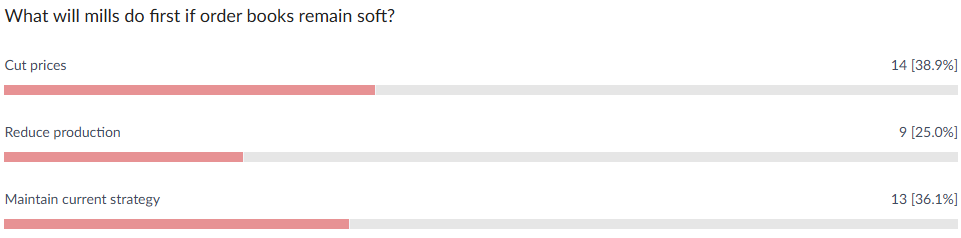 From our content partner, SteelOrbis .jpeg) US long steel prices stable with flat to down scrap as supplies are reported a bit tight Wednesday, 05 August 2026 20:22:22 (GMT+3) San Diego US domestic long steel prices were steady this week in seasonally thin trade as a result of a growing steady to down domestic scrap pricing sentiment, even as contacts now report that supply is beginning to tighten up, market insiders told SteelOrbis. Like last week, August scrap is called sideways with a $10/gt decline possible for the shred and HMS I grades used primarily to produce rebar and wire rod at domestic EAF mills. Scrap insiders report domestic scrap market fundamentals for prime grades remain positive, yet the recent removal of tariffs for Brazilian pig iron could keep a lid on those values. “Availability is spotty, but improving,” said one US Midwest long steel insider. “From our perspective, prices are unchanged. While it remains pretty busy, there is very little pressure to lower prices, despite lower scrap values.” On the US Gulf Coast, spot rebar on an FOB mill basis is assessed unchanged from one week ago at $45.50-$46.50/cwt., ($910-930/nt or $1,003-1,025/mt), following $0.50/cwt., declines a week earlier. Insiders told SteelOrbis recent lower offers of imported rebar at $44.00-45.00/cwt., (steady this week following previous $0.50/cwt., declines a week earlier) continue to exert pressure on US suppliers to reduce first-month Q3 price offers. An examination of SteelOrbis historical data shows prices for domestic rebar on an FOB mill basis have declined a total of $1.50/cwt., ($30/nt) since early July. As Mideast hostilities continue between the US and Iran, it remains unclear whether earlier reports of “wild card” long steel suppliers from Indonesia and other Asian nations such as Korea and Vietnam will continue to act as potential sources of lower-cost wire and rod, as markets advance through the third quarter and hostilities with Iran continue to disrupt local and global supply chains. Recent July 14 rebar price increases of $30/nt ($1.50/cwt.) by Nucor at its Seattle, WA, Plymouth, UT, and Kingman, AZ bar mills would seem to indicate that recent arbitrage opportunities currently are more limited. In the domestic wire rod markets, insiders report supplies remain “a bit tight but ample,” even though UK-based steelmaker Liberty Steel has about 300 of its employees at its Bartonville, Illinois wire and rod plant still on temporary furlough as of July 13 amid reports of weakening demand in the US industrial wire products segment and continued pressure from imports. The company added that US markets continue to be affected by increased volumes of “unfairly traded imported products,” which have added to pricing pressure for domestic producers. A company spokesperson said “like many manufacturers, Liberty Steel periodically adjusts production levels to match customer demand while protecting the long-term health of its business.” Liberty Steel employee furloughs were expected to last two to three weeks as the company processes existing orders, matching production with current market demand, and monitors economic conditions. And, while this week represents the third full week of furloughs, no official update on employee status at the mill was available at press time. Spot pricing this week for domestic wire rod is reported flat again on the week at $49.50-50.50/cwt., ($990-1010/nt or $1,091-1,113/mt), following a $0.50/cwt., ($10/nt) decline two weeks earlier amid reports of thin trade and marginal local demand requirements. Over the past month, wire rod prices have declined just $0.50/nt versus a larger $1.50/nt dip in rebar values. While long steel spot markets remain stable to a bit lower, a look at SteelOrbis historical data shows current domestic rebar and wire rod prices remain at their highest levels since October 2022 -the result of solid demand mostly from US data center build activities combined with a more recent doubling of Section 232 steel import tariffs enacted by US President Trump in June 2025, which slashed imports and increased domestic long steel prices. Recent domestic price increases, insiders said, have made limited rebar imports a viable option once again, despite more complicated logistics. US import long steel prices steady on low seasonal demand, reduced global oil with new Iran deal Thursday, 06 August 2026 23:15:03 (GMT+3) San Diego US import long steel prices were largely stable this week, following recent demand-related declines, as market insiders told SteelOrbis reduced Middle East uncertainty was likely to cause the energy component of the delivered price of steel to decline. This week, Iran and Oman announced a plan to route shipping traffic through lanes of its choosing in contested Strait of Hormuz. US representatives said the plan represents “progress” though the US president remains firmly against giving Iran any authority over international traffic. This week's price stability is in stark contrast to one week ago, when prices dipped about $0.50/cwt., amid continued thin US demand for imports, and lower oil prices, even as the US-Iran conflict was seen as spreading further through the Middle East as Iran launched surprise missile attacks against several of its Middle East neighbors. Even as US military activity in the region remains active, global oil prices continued to decline today with benchmark Brent Crude oil traded August 6 at $82.64 per barrel, off slightly from week-ago levels, though still up sharply from one year ago when the global oil benchmark barrels sold at $66.89/bbl. US benchmark West Texas Intermediate crude oil (WTI) traded Aug. 6 at $76.62/bbl, up slightly from the day before, a trend of up-and down price activity noted recently as markets react to swiftly changing events in the Middle East. Shipping sources told SteelOrbis that since the war with Iran began in late February, shipping rates between the US and the Middle East have nearly doubled, mostly due to a 55 percent surge in maritime bunker fuel prices and sharply higher war risk insurance premiums. Recent fuel surcharges from major carriers ranged between $65 and $165 per shipping container following the latest Middle East hostilities, shipping experts told SteelOrbis. More importantly, so-called “War Risk Surcharges” of between $1,500 and $3,500 per container were reported by various ocean carriers such as Hapag-Lloyd, sharply boosting the cost of delivered freight, including steel. Insiders said ocean freight rates remain elevated though flat this week despite lower global oil prices. On the US East Coast, the cost of bulk freight rose to $50/mt CFR from Turkey two weeks ago from $44-46/mt the week prior. At the US Gulf Coast, loaded truck rebar is reported steady at $44.00-45.00/cwt., ($880-900/nt or $970-992/mt), following last week's $0.50/cwt., decline from $44.50-45.50/nt ($890-910/nt or $981-1,003/mt). US East Coast material was also reported steady at $45.00-46/cwt., ($900-920/nt or $992-1014/mt), though off from $45.50-46.50 ($910-930/nt or $1,003-1,025/mt) two weeks earlier. In the import wire rod markets, wire rod mesh on a DDP loaded truck basis at the US Gulf was discussed steady at $46.50-48.50/cwt., ($930-970/nt or $1,025-1,069/mt), following two weeks of recent declines from $47.00-49.00/cwt., ($940-980/nt or $1,036-1,080/mt). US domestic ferrous trading for August begins with prime grades and P&S 5ft sideways, other grades down $10-20/gt Thursday, 06 August 2026 23:08:05 (GMT+3) San Diego Negotiations for the August US domestic ferrous trading cycle began on Wednesday, as mills across the country issued price announcements. In the Midwest and South/Southeast, there has been a generalized trend showing prices for prime grades and P&S 5ft, while shredded and machine shop turnings (MST) and HMS I prices are being pushed down by $20/gt. Negotiations are ongoing, and prices are not settled yet. This is aligned with expectations in the past weeks, with the possible exception of mills trying to contract HMS I prices by a deeper margin. There is a generous amount of shredded in the US; most contacts agree with that, yet some are perplexed by their desire to lower HMS I by $20/gt. From the outset, in markets like Detroit, the spread between cut grades HMS I and P&S 5ft will widen significantly. If the current price announcements hold after negotiations, HMS I would drop in that market to $355/gt delivered consumer and P&S 5ft would remain at $400/gt delivered. A $45/gt spread when $20/gt is more common. The latest reported stance by sellers in the Midwest is that they will issue offers for HMS I with a $10/gt price decrease on HMS I at most, while some are thinking a sideways scenario for the grade is not out of the cards. Flows of HMS I nationwide are not as healthy as shredded, they say, with some venturing to say that they are actually tight. By Thursday afternoon, confirmed sales are still not being reported in the Midwest. As far as the reasoning behind mills looking to push HMS I so much, the opinions have been diverse. Since HMS I and shredded are prominent in the manufacturing of long steels, some have pointed out that the price of rebar has not been performing as well as hot-rolled coil's (HRC) price. The price of rebar in the US fell to $919.8/nt FOB US mill from $949.8/nt FOB at the beginning of June. In comparison, HRC's price has risen to $1,174/nt ex-US mill from $1,106/nt ex-mill during the same period. It should be noted that some participants have mentioned that steel customers do not follow cut grades as closely as they do prime grades. Hence, the common perception is that HRC is more closely linked to #1 busheling's performance, resulting in mills closely guarding prime grades' pricing so they do not affect their steel selling prices. Additionally, as HMS I is not generated as constantly as industrial grades such as #1 busheling, it is subjected to seasonal trends such as activity changes in construction and demolition. Some also add that due to the grade's inherent inconsistencies, it is not bought by several mills, allowing those that do buy it to try and exert heavy influence on the grade's market. In the meantime, there have been confirmed sales as of Thursday afternoon coming out of the Southeast. A sideways trend is being seen for prime grades with a -$10/gt on everything else. On some deals and in some markets, there are reported sales of P&S 5ft being sold at sideways prices from last month, while in other reports the price was reduced by $10/gt. West of the Mississippi, the report is that some mills announced a sideways trend across the board. This also coincides with the latest announcements seen on the US East Coast (USEC), where mills in the Philadelphia market are seen purchasing all grades unchanged from July's settled prices. Buyers in Philadelphia stated that they already dropped $10/gt last month on all grades (except prime grades) when only shredded and HMS I's prices contracted. But it could also be that the export market on both coasts has picked up recently. In USEC, the price of HMS I/II 80:20 has improved to $375-376/mt CFR Turkey from $369/mt CFR a couple of weeks ago. It is still not sure that this upward trend will be sustainable yet; USEC exporters are reportedly firm on their offer levels as of Thursday. In the meantime, the prices to USEC docks rallied on Tuesday as HMS I increased to $260-265/gt delivered Philadelphia export yard from $245-250/gt delivered the week prior. Negotiations and sales for the domestic market are still developing across the country. Do you have any questions? Check out our FAQ!Check out the most frequently asked questions about the service and products of StaalX. We are always here to chat with you in the chat boxes from the site or on the support telephone number below. Contact us websupport@staalx.com or +1 (708) 697-3227 Follow StaalX on |








Need steel? Get an instant quote & save $500 off your first order
Search rebar, wire rod, wire mesh and more on StaalX. Check availability and book reliable delivery nationwide.
For sponsorship opportunities or advertising on StaalX News, contact us at websupport@staalx.com.