 Check it out at next.staalx.com or contact us at websupport@staalx.com for more information. Updates From This Week A Big Beam Increase is Here, What's Next?Beneath the headlines, distinct pockets of weakness persist in the steel market. Residential construction and packaging, for instance, remain quite soft, with prices struggling to gain traction. The housing market has stalled under the weight of elevated construction costs, high ownership expenses, and persistent mortgage rates. Metal packaging, meanwhile, continues to lose demand to cheaper alternative materials or, worse, imported canned goods. Yet, when steel buyers returned from the summer holiday break, they knocked on mill doors only to face tight allocations. Predictably, mills are informing customers they will receive only a fraction of their requested volumes, citing heavy commitments for the coming year. This squeeze is most acute in flat rolled market, more specifically for hot-rolled coil (HRC), but cold-rolled and coated products are steadily following suit. Import alternatives for flat-rolled steel remain scarce. Decades of entrenched antidumping and countervailing duty orders have left the U.S. market vulnerable with few relief valves during demand spikes. A similar dynamic is playing out in long products like rebar and wire rod. U.S. mills last round of trade cases recently finalized with rebar imports from Vietnam, Egypt, Bulgaria, and Algeria completely locked out from the market. While South Korea absorbed some displaced volume throughout 2026, Korean mills are now curbing offers to the U.S. as domestic steel maker coalitions lobby the Department of Commerce and the USTR for tariff-rate quotas against South Korea to curb their volume. This web of protectionism—anchored by 50% Section 232 tariffs alongside numerous AD/CVD orders—has made American steel among the most expensive in the world. Even so, domestic producers show no sign of easing off the lobbying pedal in Washington. For wire rod—where tariff protections have done little to spur new domestic capacity—buyers are increasingly dependent on a dwindling pool of suppliers. Wire drawers are placing maximum orders with domestic mills, but many older rod mills are poorly maintained and prone to unscheduled outages. Downstream manufacturers are increasingly caught in the crossfire. Companies consuming raw steel employ roughly ten to sixteen times more workers than primary steel producers, yet they must compete directly against imported finished products. Meanwhile, construction costs for both residential and commercial structures have climbed by approximately 10% since 2024. Further steel price increases appear inevitable. Mills pushed through another $2.50 cwt ($50/short ton) increase on structural beams, bringing base prices for heavy shapes into the high-$80s cwt ex-works. Merchant bar base prices have also been steadily moving up, widening the pricing gap between the products like rebar and wire rod. By contrast, wire rod and rebar have lagged somewhat despite mills reporting healthy order books. However, with October scrap pricing trending upward, rebar and wire rod are poised for a catch-up rally. Fasten your seatbelts folks: if you thought 2026 was a wild ride, the real bull market may still be ahead of us. Weekly Poll What will drive steel prices most through year-end? Last Week's Poll Result 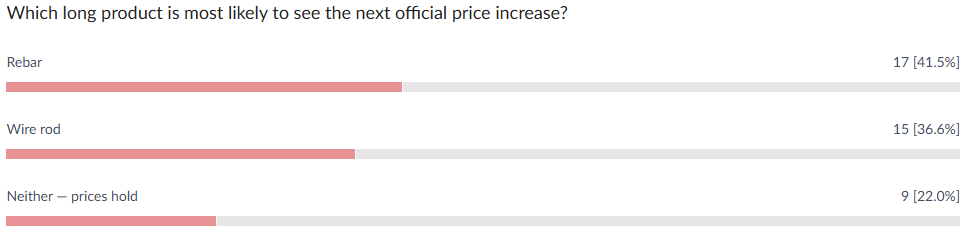 From our content partner, SteelOrbis  US long steel prices stabilize as Q4 nears amid reduced construction-related activity Thursday, 24 September 2026 21:18:39 (GMT+3) San Diego US domestic long steel prices were stable this week on the heels of recent weekly price gains as the fourth quarter nears, even as media reports this week indicate the month of August saw a sharp drop in construction-related activity, market insiders told SteelOrbis. According to a Sept. 21 report from the Dodge Construction Network, North America's largest provider of construction-related data, August construction starts were off 24.8 percent versus those reported during July to a seasonally adjusted rate of $1.34 trillion. And, while month-on-month comparisons showed a sharp drop in construction starts, activity through the first eight months of 2026 still continues to outpace levels seen at this time one year ago, the report said. Insiders tell SteelOrbis even though construction-related demand remains unsteady on a month to month basis, the combination of rising energy and raw materials costs in the way of scrap as well as tighter domestic supply as a result of seasonal plant maintenance activity was expected to remain supportive for domestic long steel prices. “In my opinion, long steel prices are likely to remain strong and it seems nothing is going to slow the momentum we expect to see continuing through the end of the year and into 2027,” said one Midwest long steel insider. “Things are tight and getting tighter every day it seems.” Following last week's $0.50/cwt., gains, the SteelOrbis US domestic rebar average price on an FOB mill basis was stable at $46.50-47.50/cwt., ($930-950/nt or $1,250-1,047/mt), though up from the $46.00-47/cwt., ($920-940/nt or $1,014-$1,036/mt) level reported two weeks earlier. “North American long products continue to show good pricing resilience as we move toward Q4,” said another SteelOrbis long steel insider. “The market is not uniformly strong as traditional residential and smaller commercial construction remains softer.” He continued. “Infrastructure, power, data centers and large institutional projects continue to provide an important base for (domestic) steel demand.” And, while continued 50 percent import tariffs continue to constrain other finished steel imports, the latest preliminary census data from the US Department of Commerce shows US imports of rebar totaled 112,306 metric tons (mt) during July, up 12.1 percent from June and up 84.6 percent from July 2025. The data also reveals that nearly 93 percent of those US rebar imports for July came from South Korea. In the wire rod markets, insiders tell SteelOrbis most think that Liberty Steel's 700,000-ton a year Bartonville wire and rod plant continues to operate following recent repairs to the plant's cranes. While the plant is reportedly running, it remains unclear at what level the plant is operating at. Calls to Liberty Steel by SteelOrbis regarding the status of the Liberty plant remain unanswered. “While Liberty appears back on line to a certain extent, reliability remains the key issue with regard to the old plant,” the Midwest insider added. “People are continuing to wonder whether the plant is keeping it's promises to customers, as well as keeping up with its recent orders.” Average domestic wire rod mesh prices on an ex-mill basis remained steady for a sixth week at $50.00-51/cwt., ($1,000-1,020/nt or $1,102-1,124/mt), while US Gulf Coast alternative DDP loaded truck basis wire rod mesh import product also was steady at $46.50-47.50/cwt., ($930-950/nt of $1,025-1,047/mt), following earlier $0.50/cwt., weekly price gains. US import long steel prices stable as Q4 nears amid bullish fundamentals Friday, 25 September 2026 18:57:38 (GMT+3) San Diego Following earlier weekly gains, US import long steel prices remained stable this week even as many of the same bullish market fundamentals seen over the past several months remain in play, market insiders told SteelOrbis. Given recent increases in US import steel volumes, and as next week's Q4 start grows closer, insiders told SteelOrbis many market participants continue to keep an eye on rising oil prices for clues about the potential for continued gains in global freight rates that could make the movement of import steel cargoes to the US even more costly. Recent strength in global scrap and billet markets also are mentioned as key concerns going forward as markets approach the start of Q4 as rising global raw materials prices continue to “trickle down” to relevant US import pricing markets. The price of US prime and shredded scrap is discussed strong sideways to potentially $10-20/gt higher for October, market insiders tell SteelOrbis. “Freight rates may be trending upwards and so, suppliers are going to start to pass through their higher costs into future pricing,” said one US Midwest long steel insider. “South Korea, Vietnam and Malaysia continue to be active suppliers for the US long steel import market.” Following last week's $0.50/cwt., gains, US East Coast import rebar on a loaded truck basis is reported steady at $46.00-47/cwt., ($920-940/nt or $1,014-1,036/mt), up from $45.50-46.50/cwt., ($910-930/nt or $1,003-1,025/mt), two weeks earlier. Pricing for equivalent import loaded truck rebar product at the US Gulf Coast also remained stable at $45.00-46/cwt., ($900-920/cwt., or $992-1,014/mt), up from $44.50-45.50/cwt., ($890-910/nt or $981-1,003/mt), two weeks prior. “While the US domestic (long Steel) market remains fairly well balanced, the more interesting development is on imports,” remarked another US Gulf Coast long steel insider to SteelOrbis. “Houston (rebar) material remains around the mid-$40s/cwt., but replacement costs are moving higher and the forward import pipeline appears thinner.” He continued. “Northeast replacement from South Korea is already being discussed around $45.00–47/cwt loaded truck, and market participants are increasingly focused on the possibility of higher replacement costs later in Q4.” In the wire rod mesh import market, insiders said DDP loaded truck material remains firm with pricing steady to week-ago levels near $46.50-47.50/cwt. Following on this past week's $0.50/cwt., incremental gains, insiders said suppliers from Vietnam and Malaysia remain active, though the potential for higher freight rates and fuel surcharges based on climbing oil prices stands to further trim already razor thin margins, they said. Steady US pricing for domestic wire rod mesh supply at $50.00-51/cwt., for ex-mill material was expected to continue to limit import opportunity, insiders said. “The import discount is still present, but it is not large enough to fundamentally destabilize domestic pricing,” the US Gulf Coast long steel insider added. “With limited alternative production and higher replacement economics, I expect wire rod to remain stable-to-firm through Q4.” On Sept. 25, global Brent crude oil traded at about $105 per barrel (/bbl), off slightly on the day, though still up more than 22 percent during September alone. Media reports from the UN General Assembly meeting in New York revealed that the US and Iran were considering a phased deal that could reopen the Strait of Hormuz and lift the ongoing US blockade of Iranian ports. Tensions in the Mideast remain high as Houthi militants in Yemen launched missiles toward Saudi cities, including Yanbu and Taif. West Texas crude oil (WTI) traded at about $92.39/bbl on Sept. 25, off about 2.3 percent on the day, though still up more than 41 percent versus one year earlier. Since the start of the US-Iran-Israel war, the price of WTI is up more than 38 percent or about $26/bbl from $67/bbl recorded on February 27. USEC scrap-to-dock prices remain stable, in Philadelphia they inch up slightly Tuesday, 29 September 2026 01:23:55 (GMT+3) San Diego Scrap-to-dock prices on the US East Coast (USEC) remained stable this week amid a positive run for the export market. Prices to the Philadelphia docks inched up for the cut grades only on the higher end of the price range. Participants in the region say they expect higher scrap-to-dock prices in the coming days, given the rise in export prices to Turkey, but exporters cite rising freight rates as a reason not to raise the cost of their inflows. They mention that higher freight rates are eating up the gains, and they need to protect their margins moving forward. Bulk freight rates from USEC remain relatively high at $52-55/mt CFR Turkey but have not grown since last week. They have risen significantly, though, from $45-48/mt CFR a couple of weeks ago. The price of crude rose in past weeks due to the US-Israel-Iran and Russia-Ukraine wars affecting global oil supplies, but while the price of crude West Texas Intermediate (WTI) peaked at around $102 per barrel on Sep 15-16, it has been retreating and currently sits at approximately $90 per barrel. Some preliminary sentiment coming out of the SteelOrbis 2026 Fall Conference and 95th Annual IREPAS Meeting in Belgrade this week has Turkish buyers pointing to slow demand for Turkish rebar and that prices may drop soon. There are also rumors of recent ex-USEC sales of HMS I/II 80:20 that do not change the current price. The price of US-origin HMS I/II 80:20 has grown by some $28.5/mt in September with the latest deals and sits at $404/mt CFR Turkey, representing a growth of 7.5 percent from $375.5/mt CFR at the beginning of the month. HMS I to USEC docks, on the other hand, has grown by 6.8 percent to $280/gt delivered New York export yard from $260-265/gt delivered during the same period. It could be argued that the growth between export prices and scrap inflows to docks has been aligned. In the meantime, the price of HMS I to New York docks remained at $280/gt delivered, P&S 5ft at $300/gt delivered, and shredder feed at $240/gt delivered. HMS I in Philadelphia grew to $280-290/gt delivered export yard from $280/gt delivered last week, while P&S 5ft rose to $310-320/gt delivered from $310/gt. Shredder feed to the Philadelphia docks was flat at $240/gt delivered. Fuel prices for trucks in the US seem to be affected in the Midwest and USEC not only by the global phenomenon, but also by a refinery in Illinois that has shut down, with no date announced for its return. Boston prices are unchanged, with HMS I at $250-260/gt delivered export yard, P&S 5ft at $260-270/gt delivered, and shredder feed at $180/gt delivered. Containerized Activity for prepared scrap in USEC is reported as slow this week, and prices have not changed. Containerized HMS I/II 80:20 remains at $325-330/mt FAS New York port, P&S 5ft at $335-340/mt FAS, and shredded at $355-360/mt FAS. Do you have any questions? Check out our FAQ!Check out the most frequently asked questions about the service and products of StaalX. We are always here to chat with you in the chat boxes from the site or on the support telephone number below. Contact us websupport@staalx.com or +1 (708) 697-3227 Follow StaalX on |








Need steel? Get an instant quote & save $500 off your first order
Search rebar, wire rod, wire mesh and more on StaalX. Check availability and book reliable delivery nationwide.
For sponsorship opportunities or advertising on StaalX News, contact us at websupport@staalx.com.