-article_image.jpg&w=1920&q=75)
 Check it out at next.staalx.com or contact us at websupport@staalx.com for more information. Updates From This Week Summer Closes with Beam Surges, Tariff Turbulence, and Import TemptationsAs buyers return for Q4 planning, stretching beam lead times revive import interest while trade friction and aging wire rod assets reshape supply lines. Labor Day is around the corner, summer holidays are wrapping up, and steel buyers across the US are dusting off their procurement desks. As buyers put their purchasing hats back on for fourth-quarter deliveries and early positioning, they are encountering a long products market marked by sharp structural contrasts. On one hand, heavy structural steel and beams are riding high on summer price hikes and extended lead times. On the other, rebar and wire rod are balancing a patchwork of regional supply shifts, trade posturing, and hyper-targeted construction demand. Structural Beams: Lead Times, Price Hikes, and the Import RenaissanceThe standout performer in the long products space remains heavy structurals and wide-flange beams. Primary domestic producers pushed through multiple price increases over the summer, backed by healthy order books that have kept rolling schedules running at or near full capacity. Crucially, these price hikes—combined with lead times stretching further into late Q4—are compelling domestic buyers to evaluate import options for heavy sections, a behavioral shift not seen in several years. While imported structural steel carries inherent lead-time risk, the expanding spread between domestic mill quotes and foreign offers is proving large enough for service centers and fabricators to re-engage overseas suppliers for upcoming project fills. Rebar & Wire Rod: Regional Splitting and Asset AnxietyIn the rebar arena, market conditions remain distinctly bifurcated along regional lines:
Despite East Coast abundance, the broader rebar market is not oversupplied; underlying consumption continues to churn material through job sites at a steady pace. Overseas, Indian mills have become active in floating rebar offers to North America. However, buyer appetite for Indian origin remains restrained. Long voyage times through volatile maritime routes make taking on 60-to-90-day price risk unappealing in a fast-moving rebar market where regional pricing can shift before vessel discharge. The wire rod segment presents a deceptive calm. Currently, wire buyers are well supplied through a balanced combination of domestic shipments and import arrivals. Yet beneath the surface, buy-side anxiety is mounting regarding the long-term viability of domestic wire rod production. Concerns surrounding aging mill infrastructure, high capital expenditure requirements, and financial strains on legacy producers have raised fears of unexpected outages or permanent capacity rationalization. On the import front, supply remains concentrated among a small cluster of Asian suppliers, though Indonesian mills are increasingly establishing a presence as an aggressive new contender for US market share. Trade Policy & Border Friction: The Washington WindTrade protectionism remains a primary lever shaping long product import flows. In Korea, rebar exporters are holding back on aggressive US volume commitments due to heightened risks of new Anti-Dumping (AD) and Countervailing Duty (CVD) filings. Domestic mills are filing trade complaints with speed and precision, confident that the political atmosphere in Washington, D.C. strongly favors trade enforcement. Simultaneously, cross-border steel diplomacy with US trade partners is experiencing severe friction:
Demand Drivers & The Scrap Cost FloorUnderpinning all long product categories is a highly bifurcated nonresidential construction market. The broader commercial building environment remains subdued—consistent with the Architecture Billings Index (ABI) lingering in contraction territory around 47–48 and total nonresidential spending holding roughly flat at under $2.2 trillion. However, the relentless AI arms race is keeping the structural market afloat. Heavy industrial demand driven by data center megaprojects, accompanying power infrastructure, and utility buildouts continues to consume massive tonnages of structural sections and rebar, forging ahead despite growing local community pushback and power grid constraints. On the raw material side, Midwest and Chicago shredded scrap prices have held firm in the $430–$450/gross ton range heading into September buy-month settlements. This scrap baseline establishes a firm cost floor for finished steel prices. While scrap stability prevents any drastic downside collapse in finished long product prices, it highlights diverging mill margins: beam producers are expanding margins on the back of summer price increases, whereas rebar producers on the East Coast face margin compression under heavy supply availability. As procurement teams finalize Q4 order books over the coming weeks, navigating lead times, trade risks, and regional pricing spreads will separate market leaders from the pack. Weekly Poll What concerns you most heading into Q4? Last Week's Poll Result 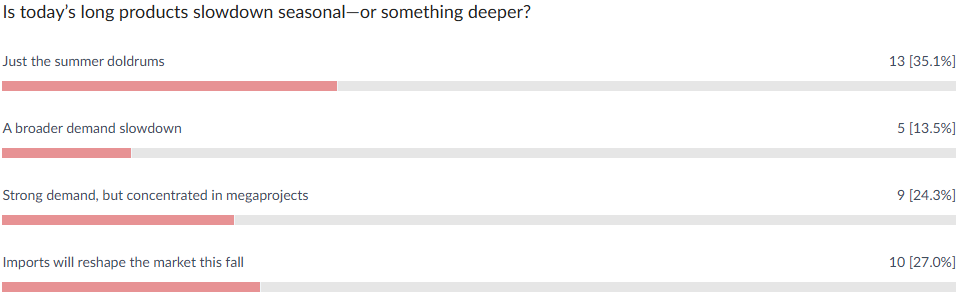 From our content partner, SteelOrbis .jpeg) US long steel prices flat amid support from data centers, tight supplies, stable to up scrap Wednesday, 26 August 2026 23:22:36 (GMT+3) San Diego US domestic long steel prices were reported steady this week, supported by continued demand from data center builds and associated AI development projects, continued reports of tightening US spot supply, especially in the US West where access to long steel imports remains more limited, as well as a developing market sentiment that September scrap prices could be flat to potentially up, market insiders told SteelOrbis. Following recent spring and summer US rebar and wire rod price increases from several key domestic mills (Nucor and CMC), weekly domestic long steel pricing has remained well supported amid reports of steady infrastructure-related construction demand even though imports recently have slipped, the result of further tightening of the gap between domestic and import long steel pricing levels. “With the cost of imports getting so close to domestic pricing levels, it's getting harder and harder to get new deals done,” remarked one US Midwest long steel insider. “Rebar supply in the Western US remains tight as access to imports there remains more limited, and fixed costs for fuel and trucking continue to rise.” US domestic rebar on an FOB mill basis is reported steady on the week at $45.50-46.50/cwt., ($910-930/nt or $1,003-1,025/mt). Insiders continue to caution that recent domestic mill focus on more profitable merchant bar and structural angle long steel products could lead to more supply tightness ahead for local rebar markets, keeping local pricing steady even if scrap and other energy-related fixed costs for steel producers and shippers begin to drop. SteelOrbis historical data shows that since the May-June period, rebar pricing has dipped about 2.2 percent from a high of $47.50/cwt., ($950/nt or $1,047/mt), while the average price of wide flange beams used in new building frames, has risen about 3.1 percent to a recent high of $85.50/cwt., ($1,710/nt or $1,885/mt) largely on steady structural steel demand from data center builds, insiders say. “People are starting to put their buying heads on now that the summer is starting to wind down,” the Midwest insider added. “We're seeing quite a bit of new spot market activity in the MBQ and structural steel sectors with prices higher and lead times longer.” He continued, “Import bookings on structural steel (MBQ and Angles) are starting to increase. Normally, domestic mills are more competitive, but things are starting to tighten up domestically.” In the local wire rod markets, it remains unclear whether Liberty Steel's 700,000-ton a year wire and wire rod plant in Peoria, Illinois, will return to service as planned on Aug. 28 following three weeks of “critical repairs” to the plant's cranes, insiders said. Until there is more clarity on whether repairs are complete and production ramping up, insiders expect pricing near term to remain strong, following last week's 50-cent-per ton price increase. In the wire rod markets, insiders report wire rod mesh sales on an ex-mill basis steady on the week at $50-51/cwt., ($1,000-1,020/nt or $1,102-1,124/mt). “People are nervous about ongoing wire rod production from Liberty at the moment,” the insider said. “Following this recent outage, people are really starting to question the longevity of the mill. If this mill were to be be shut, it would leave a huge hole to fill in the market.” On the supply side, as previously reported by SteelOrbis, according to preliminary census data from the US Department of Commerce, US imports of rebar totaled 100,216 metric tons (mt) in June this year, down 20.2 percent month on month and down 20.6 percent year on year. The US imported the most rebar from South Korea in June with 95,054 mt, compared with 79,038 mt in May and 141 mt in June 2025. Other top sources of imports include Mexico with 2,348 mt and the Dominican Republic with 1,429 mt. On the raw materials side, US scrap prices during August supply negotiations settled steady for prime grades, though HMS grades -used mainly in rebar production- declined $10-20/gt in the Midwest, South, and Southeast regions. Early market sentiment for next month's scrap trade reveals a similar situation setting up for September, though prime grades could end stronger, especially in the tighter Western US, insiders said. US import long steel prices steady to up on rising fixed costs for shippers, imports slip Thursday, 27 August 2026 22:35:20 (GMT+3) San Diego US import long steel prices were steady to up slightly this week amid reports of rising fixed costs faced by global steel shippers. Those rising fixed costs for fuel, insurance and stevedoring services continue to shrink already razor-thin margins on imported material, making earlier gains seen in imports versus domestic supplies less financially attractive, insiders said. “Fixed costs for importers are way up because everything continues to get more and more expensive,” said one US Midwest long steel insider to SteelOrbis. “The price of insurance and fuel is way up for shippers because of the Iran war, and recent consolidations seen in the stevedoring services business has resulted in higher prices at the docks.” On the US Gulf Coast, loaded truck import rebar is priced on average $44.50-45.50/cwt., ($890-910/nt or $981-1,003/mt), up from $44.00-45.00/cwt., ($880-900/nt or $970-992/mt), one week earlier. US East Coast import material also was reported 50 cents/cwt., higher at $45.50-46.50/cwt., ($910-930/nt or $1,003-1,025/mt), up from $45.00-46/cwt., ($900-920/nt or $992-1014/mt) one week earlier. As previously reported by SteelOrbis, according to preliminary census data from the US Department of Commerce, US imports of rebar totaled 100,216 metric tons (mt) in June this year, down 20.2 percent month on month and down 20.6 percent year on year. The US imported the most rebar from South Korea in June with 95,054 mt, compared with 79,038 mt in May and a mere 141 mt in June 2025. Other top sources of imports include Mexico with 2,348 mt and the Dominican Republic with 1,429 mt. Shipping insiders said various fixed costs for services at US ports are up sharply this year as a result of increased consumer spending and disposable income which continues to boost containerized import volumes, leading to reports of increased congestion backlogs at US ports. Recent increases in labor costs, increased surcharges to speed cargo flows, as well increases to fund more comprehensive port congestion measures also continue to add to shipping costs, they said. According to an August, 2026 report from the North American Industry Classification System (NAICS), a government agency that allows for the analysis of statistical data on the North American economy, “Recent global disruptions in energy supply as a result of the Iran war also have choked the Strait of Hormuz, letting US petroleum and LNG exports backfill demand and lift US Gulf Coast throughput.” In the import wire rod mesh markets, prices on a weekly basis were flat for yet another week with DDP loaded truck basis material quoted steady at $46.00-47/cwt., ($920-940/nt or $1,014-1,036/mt). Despite weekly declines that have continued in wire rod mesh pricing since mid-July, insiders said wire rod import prices should remain firm near term pending news from Liberty Steel's 700,000 ton per year Bartonville, Illinois-based wire and rod plant on whether “critical repairs” to cranes at their downed facility were completed as planned by August 28. In the domestic wire rod market, weekly prices remained flat at $50.00-51/cwt., ($1,000-1,029/nt or $1,102-1,124/mt), a level where pricing has remained steady since Nucor announced a $20/nt increase ($1.00/cwt.) earlier this month. US domestic scrap's best scenario in Sep could be sideways; a possible downturn in cuts and shred is also rumored Thursday, 27 August 2026 23:01:44 (GMT+3) San Diego The domestic scrap market in the US remains bearish as several factors continue to exert downward pressure. Buyers and sellers in the Midwest and South report healthy inventories and scrap generation flows. Additionally, the number of maintenance shutdown days lined up for September and October could curtail scrap demand (some estimates place the total number of shutdown days for all mills in the country at close to 100 days between September and October). Yet, the maintenance shutdowns are not mentioned as the biggest factor, or even a prominent one, affecting the market; healthy scrap volumes and inventories seem to be the first ones mentioned in conversations with sources. It should be noted that if cut grades or shredded prices drop in September, they could fall by $10-20/gt depending on the market, same as they did in August. Machine shop turnings (MST) could follow cut grades as usual. Scrap demand remains healthy; nonetheless, that is also something mentioned by most US contacts. The installed capacity utilization rate for the US steel sector confirms this; it has basically stayed at 80 percent since the start of April, according to data from the American Iron and Steel Institute (AISI) . It has climbed as high as 81 percent and not dipped below 79.1 percent in that period. Steel orders are still reported as robust, and the US purchasing managers' index in July is at its highest point in more than four years, 55.6 percent. The index has been growing for seven months and rose from 53.3 percent in June, according to data from the Institute for Supply Management (ISM). It should be noted that in its latest July report, the ISM lists steel, and specifically hot-rolled coil, among the commodities in short supply in the US. The prices for finished steel continue to grow relentlessly. In August, the price of hot-rolled coil rose to a current level of $1,197.74/nt ex-works US mill from $1,174.74/nt ex-works. Additionally, the price of pig iron has been stable in the past few weeks. US import tariff speculation on pig iron paused trading with Brazil for a number of weeks. The price has lowered since June to $500-505/mt CFR New Orleans (NOLA) from $525-530/mt CFR NOLA, yet remains above $430-435/mt CFR one year ago. Moreover, the recent developments in the Russia-Ukraine war have affected global pig iron supplies, as a couple of Ukraine's biggest producers were directly affected. This could shore up the price of pig iron in the next few weeks. Q4's bright spot October is expected to be more of the same, a soft-sideways pricing environment for scrap with a clean sideways trend across all markets as the best-case scenario. But for November and December, things could change; several US participants mention that prices are expected to go up at the end of the year. As the winter weather starts to affect scrap generation (and transportation) in many parts of the country, mills are expected to ramp up their purchases at the start of November. It is a seasonal trend. Last year, domestic scrap prices dropped in March and rebounded in November, and for the rest of that winter season, which was particularly harsh. Although in 2024, scrap prices fell in March as well and did not recover till January of 2025. Do you have any questions? Check out our FAQ!Check out the most frequently asked questions about the service and products of StaalX. We are always here to chat with you in the chat boxes from the site or on the support telephone number below. Contact us websupport@staalx.com or +1 (708) 697-3227 Follow StaalX on |








Need steel? Get an instant quote & save $500 off your first order
Search rebar, wire rod, wire mesh and more on StaalX. Check availability and book reliable delivery nationwide.
For sponsorship opportunities or advertising on StaalX News, contact us at websupport@staalx.com.