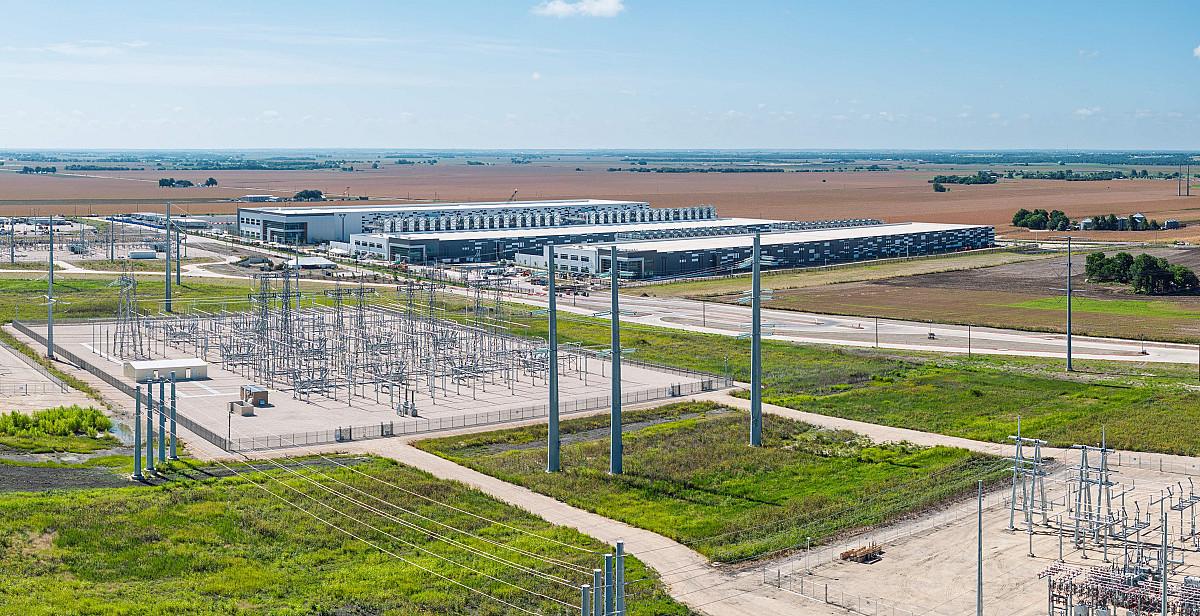
 Check it out at next.staalx.com or contact us at websupport@staalx.com for more information. Updates From This Week The Real Bull Market Is Still AheadWe aren't living in normal times in the age of AI. So far, we’ve only gotten a taste of what artificial intelligence can do—ranging from utopia to dystopia—but the physical infrastructure must be built before we face whatever future awaits. There is a robust data center backlog extending all the way to 2030, with projected capital expenditures reaching $5–6 trillion. And that doesn't account for the massive electricity generation and grid upgrades required to power those facilities. Because energy infrastructure takes far longer to deploy, this cycle of heavy steel demand could easily extend over the next decade. From almost every perspective, steel demand is set to be extraordinary for at least the next five years—or until the AI kill us all. So for now, enjoy the ride. That doesn't mean prices will move up in a straight line. The market will still experience its share of peaks and valleys. But for the next three months, the current buying momentum should comfortably carry us through year-end. We are already feeling the heat in flat-rolled products, structural shapes, and merchant bars, with suppliers announcing steady price increases and allocations. While rebar and wire rod look relatively quiet for the time being, expect conditions to tighten as November and December progress. Shredded scrap is already projected to bump up $20–$30/ton in October, and domestic mills will have little reason to absorb that cost bump. A price increase for rebar and wire rod could be just around the corner. On the supply side, import volumes for rebar and wire rod remain subdued. The primary wildcard is Mexico. Rumors continue to circulate that tariffs on Mexican steel could drop from 50% back down to 25% under a broader trade agreement. If realized, Mexican supply—particularly rebar—will quickly re-enter the U.S. market in significant volumes, unless a Tariff Rate Quota (TRQ) is put in place to cap imports. Weekly Poll How long will AI and data center construction keep steel demand strong? Last Week's Poll Result 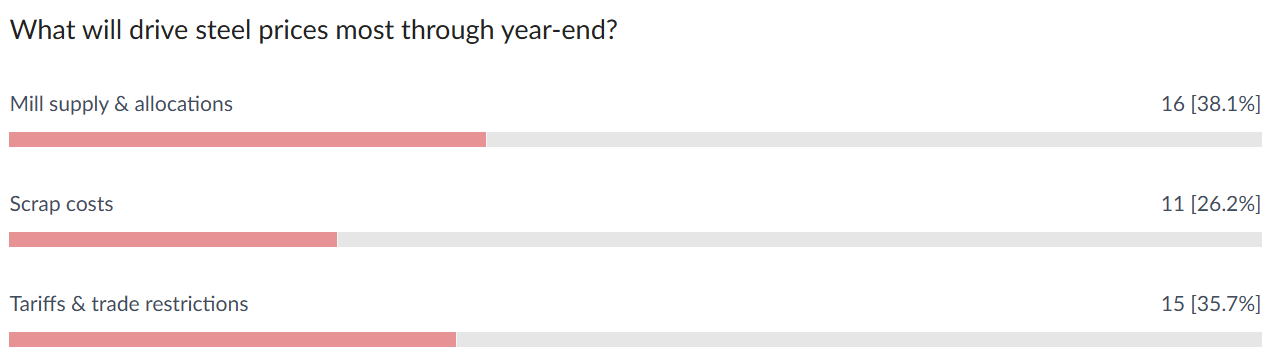 From our content partner, SteelOrbis  US long steel prices mostly flat as markets evaluate higher October scrap trade Thursday, 08 October 2026 21:01:43 (GMT+3) San Diego US weekly long steel prices remained flat for a third week at the start of the Q4 period, even as market fundamentals expected to affect rebar and wire rod demand continue to show bullish trends, market insiders told SteelOrbis. As October scrap trade began to reveal higher trade levels earlier this week, long steel insiders said domestic long steel pricing will remain well supported. Although scrap trading continued as SteelOrbis US weekly long steel report went to press, scrap insiders reported that mills were paying $10-30/gt premiums for most grades of October material versus reported September price levels in the US Midwest and Southeast regions. And, as available supplies continue to tighten across the steel complex, insiders told SteelOrbis long steel prices were reported on the rise in the Western US for markets west of the Mississippi River, with posted prices for rebar said to be increasing by about $40/nt ($2.00/cwt.) following posted mill price increases from Commercial Metals Corporation (CMC). Other regional mills were expected to follow CMC's lead as a result of dwindling western local spot supply, insiders said. Following $0.50/cwt., gains three weeks earlier, the SteelOrbis US domestic rebar average price on an FOB mill basis remained steady at $46.50-47.50/cwt., ($930-950/nt or $1,250-1,047/mt), though up from the $46.00-47/cwt., ($920-940/nt or $1,014-1,036/mt) level reported earlier. In reaction to questions about future long steel pricing heading through Q4, one US Midwest-based SteelOrbis insider commented, “I think the short answer is that demand for steel to support the growth from data center builds as well as the construction of the southern US border wall is substantial,” he said. “Demand is really starting to come up following a break in the lull brought about by summer vacations.” He continued. “People are starting to inquire about securing additional spot material and the mills are saying we don't have very much available as a result of low imports, higher freight rates and other rising transportation costs, as well as continued low levels of inventory on the ground.” Insiders added that recent gains seen in flat steel markets are starting to “trickle down” into the long steel markets as well. “I don't think people realize the scale of just how just how substantial the growth in AI and other infrastructure demand for steel really is,” the insider added. “Later on following data center development, we're going to see strong growth in power plant construction, which could sustain good steel demand across the industry for several additional years, especially since a lot of recent projects have been delayed by recent public opposition campaigns against the growth of AI and data centers.” Media reports indicate annual AI infrastructure spending could reach about $1.5 trillion by 2031, according to Bain, a Boston-based global management consulting firm. Through 2030, the firm projects a cumulative $5-6.5 trillion in data center spending. To justify those outlays, the AI market would need to approach $6 trillion in annual revenue by 2031, the company report said. And as growth is projected to spike, increased community opposition is also impacting timelines. Local opposition blocked or delayed at least 75 projects worth $130 billion in Q1 2026 alone, nearly matching the impacts in all of 2025, according to the firm. In the local wire rod and wire mesh markets, prices for ex-mill US supply remained steady yet again with most trades noted unchanged at $50.00-51/cwt., ($1,000-1,020/nt or $1,102-1,124/mt). Traders continue to report supply as “reasonably balanced” even as no update on the ongoing status of the Liberty Steel mill in Peoria, Illinois has yet been made available to SteelOrbis. Insiders said the mill likely continues to operate, following recent repairs to cranes, though likely at a reduced portion of its 700,000-ton per year capacity, due to ongoing concerns over dated equipment and ongoing staff reductions due to recent employee furloughs. Additional advances in oil prices near term are expected to further support delivered spot prices for available steel spot tons, insiders said. It remains unclear at this time, they said, whether any steel plants will be shut down or ordered to reduce capacity as a precaution against the effects of the advancing storm. Insiders said fear of Hurricane Isaias, soon to be on the doorstep of the US northern Gulf Coast, and fear that crude movement through the Strait of Hormuz will slip again continues to prop up values for West Texas Intermediate (WTI) and global Brent crude oil. At last print, WTI was up nearly 5 percent on the day to about $92.50 per barrel (/bbl), while Brent crude oil surged about 3 percent on the day, breaching the $100/bbl threshold to about $103/bbl. Fox Weather has the storm track running just offshore for now, heading east-northeast, with landfall projected for late Friday or early Saturday somewhere between the Alabama coast and the Florida Panhandle, Gulf Shores to Pensacola in the current cone. Isaias already is a hurricane, the first of the Atlantic season, with winds near 80 mph and pressure down around 979 millibars, and it is still expected to strengthen into a strong Category 1 or a Category 2 before it comes ashore. “So far what we are seeing is precautionary, not a full shutdown,” a media report stated. “Operators have pulled non-essential crews, and as of yesterday's Marine Minerals Administration count about 512,000 barrels a day of Gulf of America oil was shut in, roughly a quarter of offshore output, along with about 16 percent of Gulf natural gas. Shell, Chevron and BP are among the names evacuating platforms. Refineries are getting ready,” the report said. “The overnight shift in the track toward Alabama and the Panhandle should take some of the heat off the big Mississippi River plants, Garyville, Norco, Chalmette, Meraux, however, there remains about 2.7 million barrels a day of refining capacity in or near the broader risk zone.” USEC scrap-to-dock prices trend sideways another week Tuesday, 06 October 2026 23:57:33 (GMT+3) San Diego Scrap-to-dock prices on the US East Coast (USEC) trended flat another week as the export market has reached a point of inflection and the US domestic October trading cycle is developing. As of Tuesday, only a few mills in the Cleveland and Detroit regions have announced price changes for October, with prime grades up by $10/gt compared to September's settled prices, and everything else up $20/gt. No mills have announced prices in USEC, the South, or the Southeast. Southeast sellers expect to begin trading on Wednesday, while some sellers in Philadelphia mentioned they were receiving bids from the mills late Tuesday afternoon. Participants in the USEC scrap sector are reportedly waiting for the domestic market to settle before selling or buying more scrap for the export market. Additionally, another sale from USEC to Turkey is expected to bring more clarity to the export market. The price of US-origin HMS I/II 80:20 had grown by $28.5/mt in September, reaching $404/mt CFR Turkey, but the latest Turkish purchase (from the Netherlands) suggests that the price could come off by $4/mt to $400/mt CFR. In the meantime, the price of HMS I to New York docks remained at $280/gt delivered, P&S 5ft at $300/gt delivered, and shredder feed at $240/gt delivered. HMS I in Philadelphia remained at $280-290/gt delivered export yard, P&S 5ft stayed at $310-320/gt delivered, and shredder feed was flat at $240/gt delivered. Boston prices are unchanged, with HMS I at $250-260/gt delivered export yard, P&S 5ft at $260-270/gt delivered, and shredder feed at $180/gt delivered. The cost of bulk freight from USEC is also adding a little more uncertainty, as the rate has reportedly peaked at $58/mt CFR Turkey last week and has fallen to the mid-50s again. It is still considered expensive. Regarding higher oil prices and their influence on the export market, Phil Flynn of Price Futures Group said to SteelOrbis, “On steel, where freight is a much bigger share of the landed cost than it is on high-value goods, that turns a workable import or export model into a marginal one almost overnight. Add war-risk premiums and longer routings around the Gulf and the Red Sea, and ocean transport is no longer a rounding error in the steel trade. It is the swing factor. Yet hopefully, as we see prices stabilize, we can see a drop next month.” Do you have any questions? Check out our FAQ!Check out the most frequently asked questions about the service and products of StaalX. We are always here to chat with you in the chat boxes from the site or on the support telephone number below. Contact us websupport@staalx.com or +1 (708) 697-3227 Follow StaalX on |








Need steel? Get an instant quote & save $500 off your first order
Search rebar, wire rod, wire mesh and more on StaalX. Check availability and book reliable delivery nationwide.
For sponsorship opportunities or advertising on StaalX News, contact us at websupport@staalx.com.