 Check it out at next.staalx.com or contact us at websupport@staalx.com for more information. Updates From This Week Merchant Bars Get a Boost—Which Product Is Next?September started with yet another price increase by long product mills. Despite stable scrap pricing, backed by solid baseline demand, Nucor stepped forward with an announced price increase for merchant bars ranging from $30 to $50 per ton. Demand for these structurals remains exceptionally strong, buoyed by data center construction and mega-projects nationwide. So far, rebar and wire rod have not seen a matching official boost. On the rebar front, two newly minted domestic mills are actively competing for market share, while higher-than-usual import volumes arrived at U.S. ports during the third quarter. However, West Coast and Midwest inventories remain lean, meaning another domestic price increase is not out of the question. Lower rebar prices earlier in the season kept fourth-quarter import commitments quiet; if demand picks up following the seasonal summer slowdown, supply on the East and Gulf Coasts could tighten quickly. Importers have little flexibility to react to sudden demand spikes. Foreign mills currently require lead times of at least four months from order placement to port delivery. In the wire rod market, Nucor implemented an unannounced $20-per-ton price increase, which quickly made its mark across trade channels. Domestic mill outages and planned maintenance shutdowns continue to constrain domestic supply, while import options remain restricted. Only two or three low-cost foreign sources remain competitive; the rest face trade restrictions, anti-dumping duties, or a general lack of interest in the U.S. market. As a result, U.S. steel consumers continue to pay some of the highest prices in the world. Compounding the problem, consolidation among stevedoring companies at key steel-handling ports—combined with rising dockside labor costs—has driven terminal discharge rates up by as much as 40% over the past several years. This presents yet another obstacle for importers, adding overhead on top of the 50% Section 232 customs tariffs. The final burden is land freight. Escalating diesel fuel costs and elevated trucking rates make long-distance highway transport prohibitive, squeezing margins for domestic mills and importers alike. Weekly Poll Which long product is most likely to see the next official price increase? Last Week's Poll Result 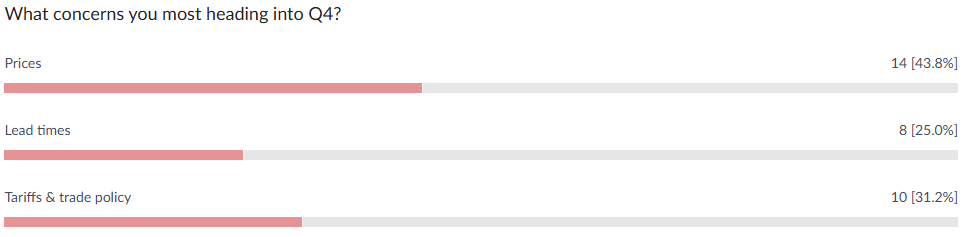 From our content partner, SteelOrbis  US long steel prices mostly stable in slow trade after Labor Day holiday Thursday, 10 September 2026 19:20:15 (GMT+3) San Diego US domestic long steel prices were reported mostly steady to previous levels in a slow trade start this week as market participants returned to offices following vacations and the extended Labor Day weekend, market insiders told SteelOrbis. And, while pricing remains largely unchanged, survey respondents report supply and demand “fairly balanced” as a result of ongoing AI data center projects and infrastructure builds even as reports of tighter supplies continue. A combination of planned maintenance outages for the remainder of September and the approaching Q4 period, amid more reports that domestic steel mills continue to shift the focus of future rolling schedules, continues to keep markets firm, they said. “My best guess is that we will see domestic rebar and wire rod pricing remain fairly steady near term and potentially begin to increase toward the end of the month,” remarked one US Midwest-based long steel insider. “Rebar supply remains a bit tight as mills continue to concentrate rolling schedules on more profitable merchant bars, beams and angles. Heavier steel shapes are getting harder and harder to come by as well.” In the domestic rebar markets, US domestic rebar on an FOB mill basis is reported steady at $46.00-47/cwt., ($920-940/nt or $1,014-1,036/mt), following previous weekly gains of $0.50/cwt., driven by shifting domestic mill rolling. Insiders tell SteelOrbis the recent shift away from standard rebar to more profitable merchant bar and structural angle long steel products could be supportive for local rebar pricing near term even if scrap and other energy-related fixed costs for steel producers and shippers trend down. September Midwest HMS scrap used in rebar production was reported flat to August at $435-360/gt, while shredded material mostly used in wire rod production traded steady to August levels at $410-430/gt, scrap traders told SteelOrbis. Only prime scrap in the Cleveland, Ohio, vicinity was reported $10/gt higher, they said. In addition to earlier reports of mill announcements of rebar and wire rod price increases, on Sept. 4, Charlotte, North Carolina-based Nucor announced through its Bar Group that it would increase the price of equal and unequal angles under 4 inches in diameter by $30/ton ($1.50/cwt.) Nucor also announced that select larger sizes over 4 inches would increase by an additional $20/ton for a total increase of $50/ton ($2.50/cwt.) Existing orders as of the close of business Sept. 4 will remain price protected if shipped by close of business on Sept. 21, they said. In the wire rod market, insiders told SteelOrbis they believe Liberty Steel has resumed limited wire and rod production at its 700,000 ton per year Bartonville, Illinois, facility, though no confirmation remains available to date from the mill. The facility was reported closed in media reports Aug. 7 for three weeks while “critical repairs” to the plant's cranes were completed. Media reports also indicated staff at the mill remain on limited furlough as a result of “unfair competition from imports and limited wire demand.” Spot wire rod mesh pricing on an ex-mill basis was discussed stable on the week again at $50.00-51/cwt., ($1,000-1,020/nt or $1,102-1,124/mt), while US Gulf Coast import alternative DDP loaded truck basis product also was reported steady at $46.00-47/cwt., ($920-940/nt or $1,014-1,036/mt), market insiders told SteelOrbis. And, while pricing for import long steel alternative supply remained steady, some insiders think import pricing could become more competitive near term. “Imports are still coming in to the US Gulf, some say at more competitive numbers than we have seen over the past 3-4 weeks,” remarked one US Gulf Coast long steel insider. SteelOrbis historical data shows wire rod pricing has remained flat since the beginning of Q3, while rebar values have declined a mere $0.50/cwt., or $10/nt., during the period. This week, a media report released by the Associated General Contractors of America (AGCA) found that overall construction spending for July dipped 0.5 percent from June, while year over year, construction spending remains off 3.8 percent. The report further stated that current infrastructure spending remains driven almost exclusively by AI data center builds, new power projects, and highways, even as manufacturing construction dipped for a sixth strait month, while other private office construction fell a larger 10.6 percent. On a more positive note, the AGCA report found that during August, contractors added 22,000 new jobs, while overall construction unemployment fell to a record low of 3.1 percent. The report also said that despite soft market conditions in certain sectors, 73 percent of surveyed firms plan to hire additional workers over the coming year, as data center construction continues to strain the available labor pool and intensify competition for qualified craft professionals. US import long steel prices steady amid reports of "subdued" import activity Thursday, 03 September 2026 20:56:08 (GMT+3) San Diego US import long steel prices were steady this week, following a slight uptick one week earlier, as long steel import insiders said that trading activity was “subdued” as most imported material booked earlier in July and August had arrived at US Gulf Coast and East Coast ports and few new import bookings were noted, they told SteelOrbis. “Most of the (long steel) import material I've seen booked already has come in,” remarked one US Midwest long steel insider, predicting a reduction in future imports. “Based on what we're seeing in the markets, I'm thinking that Korean imports of rebar are likely to be reduced for October shipments.” Over the past several months, cheap Korean rebar imports have dominated long steel import conversations, especially on the US Gulf Coast, spurring more recent market discussion of rising Korean offers as a means by Korean exporters to head off future claims of dumping by US regulators. In addition to rising offers by suppliers, other fundamentals remain in play, they said. As reported earlier by SteelOrbis, recent increases in global fixed costs, the result of higher US stevedoring fees and other labor and fuel-related costs are starting to reduce the attractiveness of imported material, insiders told SteelOrbis. Following on last week's small price uptick on reported rising costs, loaded truck rebar at the US Gulf Coast is priced on average $44.50-45.50/cwt., ($890-910/nt or $981-1,003/mt), unchanged from one week earlier. US East Coast import material, which also was reported 50 cents/cwt., higher one week ago at $45.50-46.50/cwt., ($910-930/nt or $1,003-1,025/mt), also remained steady, market insiders told SteelOrbis. As previously reported by SteelOrbis, according to preliminary census data from the US Department of Commerce, US imports of rebar totaled 100,216 metric tons (mt) in June this year, down 20.2 percent month on month and down 20.6 percent year on year. The US imported the most rebar from South Korea in June with 95,054 mt, compared with 79,038 mt in May and a mere 141 mt reported for June 2025. Other top sources of imports include Mexico with 2,348 mt and the Dominican Republic with 1,429 mt. One long steel import insider summarized the recent Korean import rebar situation into the US as such. “Based on the import statistics we're seeing reported for rebar, South Korea has sold more volume than almost twice the combined capacity of two mini mills, or about equivalent to Hybar's capacity so far this year,” he said. Hybar, initially referred to as Highbar LLC, operates a 630,000 ton-per-year renewable energy-powered rebar mill located at Osceola, Arkansas. The company recently announced in early July that due to overwhelming investor interest, they would build a second similar-sized expansion mill at the same site. The first mill was expected to be at 100 percent of its rated capacity by end-summer or early fall, according to media reports. In the import wire rod markets, insiders expect import pricing to remain reasonably strong near term following reports that Liberty Steel's 700,000-ton-per-year Bartonville, Illinois wire and rod plant was expected to remain shut or operating at at reduced capacity for at least one more week, following an earlier shut down on Aug. 8 while three weeks of “critical repairs” to the facility's cranes were expected to have been completed. Repeated attempts to clarify the plant's operational status with Liberty remain unanswered. In the import wire rod mesh markets, prices on a weekly basis were flat for yet another week with DDP loaded truck basis material quoted steady at $46.00-47/cwt., ($920-940/nt or $1,014-1,036/mt). In the domestic wire rod market, weekly prices were also flat at $50.00-51/cwt., ($1,000-1,029/nt or $1,102-1,124/mt), a level where pricing has remained steady since Nucor announced a $20/nt increase ($1.00/cwt.) earlier this month. At current, about 50 percent of the most recent Nucor wire rod price increase has been accepted by the market, insiders told SteelOrbis, as domestic wire demand is reported to be seasonally lower with low-priced anti-competitive import material pressuring domestic mills like Liberty Steel to trim wire and rod output and furlough plant staff until “market conditions improve.” USEC scrap to docks prices remain flat, participants expect increases soon Tuesday, 08 September 2026 22:40:46 (GMT+3) San Diego In the US East Coast (USEC), scrap-to-dock prices remained unchanged this week yet again, but participants mention that they expect increases to come in soon given the upward trend in the export market. The price of US-origin HMS I/II 80:20 climbed by $6.6/mt since last week based on a couple of US deals late last week and a new one from Scandinavia on Tuesday, setting the price at $380-383/mt CFR Turkey. Moreover, some participants in the US report that certain market factors point to more growth in exports, and exporters are reportedly not issuing offers but awaiting bids. The cost of fuel has increased in the past few days. The price of crude West Texas Intermediate (WTI) has grown by about $8 per barrel in the past seven days, reaching $93 per barrel on Tuesday. There have not been confirmed reports of a higher rate for USEC bulk freight to Turkey, but exporters are reportedly expecting an increase soon and will look to protect their profit margins in future deals. Additionally, contacts in USEC mention that the higher Turkish finished steel prices could continue to support a growth in exports. SteelOrbis recently reported that some Marmara-based mills increased their rebar prices by $5/mt at the start of this week due to currency fluctuations and higher import scrap prices, while hot-rolled coil (HRC) increased by $5/mt last week due to limited supply after some producers underwent scheduled maintenance shutdowns and also as a result of higher scrap prices. US domestic scrap prices in USEC settled last week sideways across the board for September. In Philadelphia, the price of #1 busheling remained at $450/gt delivered consumer, while HMS I prices were also unchanged from August settled prices at $330-340/gt delivered. In New York, the price of HMS I remained at $260-265-gt delivered export yard, P&S 5ft was unchanged at $280-285/gt delivered, and shredder feed was flat at $225/gt delivered. In Philadelphia, the trend was similar, with HMS I at $260-265/gt delivered export yard, P&S 5ft at $290-295/gt delivered, and shredder feed still being bought by exporters at $225/gt delivered. In Boston, the price of HMS I was unchanged at $230-240/gt delivered export yard, and P&S 5ft was also flat at $240-250/gt delivered. Shredder feed was the lone exception this week, climbing by $15/gt to $180/gt delivered on account of tighter supplies in the region and competition from more generous prices in New York and Philadelphia. Containerized Prices for prepared scrap for the USEC export market also remained unchanged, with containerized HMS I/II 80:20 sitting at $325-330/mt FAS New York (NY) port, containerized P&S 5ft is still at $335-340/mt FAS, and shredded at $355-360/mt FAS. The outlook for this market is more stable than bullish, as some Asian import markets have shown resilience. For example, last week, offers of US-origin HMS I/II 80:20 to Taiwan increased by $2/mt to $334/mt CFR on account of higher billet and rebar prices, while offers of the same grade to Bangladesh were up by $10/mt last week to $390-395/mt CFR Chattogram while buyers still seek to suppress price growth for imports. Do you have any questions? Check out our FAQ!Check out the most frequently asked questions about the service and products of StaalX. We are always here to chat with you in the chat boxes from the site or on the support telephone number below. Contact us websupport@staalx.com or +1 (708) 697-3227 Follow StaalX on |








Need steel? Get an instant quote & save $500 off your first order
Search rebar, wire rod, wire mesh and more on StaalX. Check availability and book reliable delivery nationwide.
For sponsorship opportunities or advertising on StaalX News, contact us at websupport@staalx.com.