-article_image.jpg&w=1920&q=75)
🚀 It’s Live: Meet StaalXneXt (Beta)StaalXneXt Beta is now live — an invitation-only marketplace built for serious buyers and sellers. Access exclusive supply, unlock hidden inventory, and connect with trusted partners across domestic and global markets. From spot opportunities to future orders — with flexible Net 30 / 60 / 90 payment terms — StaalXneXt gives you the control the traditional market never did. .png) Explore the upgrades at www.staalx.com or get in touch today with websupport@staalx.com to see the difference. Updates From This Week The Steel Market is Already Feeling the Heat The world is watching the evolving conflict involving Iran with a rollercoaster of expectations. While there is a current glimmer of hope for de-escalation and a permanent ceasefire, the U.S. steel market isn't waiting for a peace treaty to react. The impacts are already reverberating through the supply chain. Domestic Logistics: A Tight Squeeze The immediate fallout is visible in the domestic freight market. Shippers are facing a "double whammy" of rising truck and rail rates alongside severe capacity constraints. Flatbed tender rejection rates exceeded 40% in March, with spot rates hitting record highs of $3.95 per mile. Even when shippers agree to these premium rates, securing equipment to move steel remains a challenge. With rail carloads also at their highest levels since 2019, the logistical floor is rising, and rates are expected to climb further through Q2. The Import Stagnation Import bookings have effectively stalled since the conflict intensified. Steel supply from the Persian Gulf—historically a key source for billets and long products—has been restricted by disruptions at major hubs like Jebel Ali and airstrikes on Iranian production facilities. Although the US does not import many goods from the Middle East, restrictions increased the price of steel in Asia, Africa and Europe. Furthermore, ocean freight rates have ballooned, driven primarily by soaring bunker fuel costs and the need to bypass high-risk zones. While domestic long product pricing has remained relatively stable for now, these "landed" import offers are becoming prohibitively expensive. We don’t expect international freight or steel prices to retreat quickly, even if oil prices experience a sudden drop. This lack of current bookings will likely trigger a supply "air pocket" in three to four months, tightening the market and driving domestic prices upward regardless of demand strength. A Tale of Two Products: Wire Rod vs. Rebar The Wire Rod market appears particularly vulnerable. Already suffering from a supply deficit, it lacks the incoming capacity seen in other segments. Conversely, the Rebar market has a sturdier cushion; two new mill capacities are coming online, and a healthy volume of imports is scheduled to arrive through the second quarter, providing a temporary buffer against the severe shortage. The Bottom Line The damage to the supply chain is already done. Whether we are "out of the woods" depends on a volatile geopolitical climate and the shifting temperament of the commander in chief. Weekly Poll Will the “import air pocket” in 3–4 months significantly tighten supply? Last Week's Poll Result   🎧 Missed Episode 20? Catch up now — we break down why U.S. construction costs are surging and why the worst may still be ahead. From rising diesel and freight costs to tightening trucking capacity and supply chain disruptions, this episode explains what’s really driving cost inflation across steel and construction materials. Listen now on ▶️ YouTube | 🎵 Spotify | 🎙 Apple Podcasts 👉 Follow the StaalX Construction & Steel Podcast for weekly insights on market shifts, freight trends, and sourcing strategies. 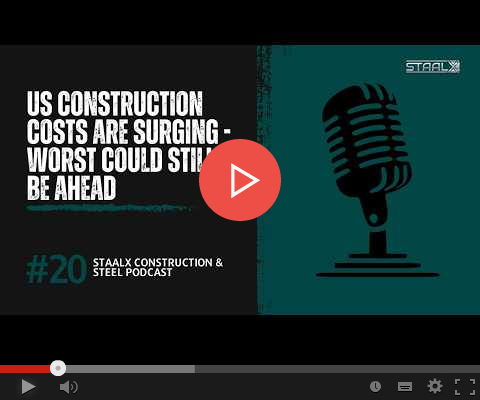 From our content partner, SteelOrbis .jpeg) US domestic long steel prices steady to down as war tensions ease, oil prices volatile Thursday, 02 April 2026 20:18:39 (GMT+3) San Diego US long steel prices were steady to a bit lower this week in thin trade amid reduced war jitters, and continued volatility in oil prices as media reports indicate the ongoing conflict in Iran could end soon, market insiders told SteelOrbis. Insiders told SteelOrbis they expected US President Trump would announce hostilities will cease within two to three weeks at an address to the Nation the evening of April 1. The issue of the re-opening of the currently closed Stait of Hormuz, where about 20 percent of global oil supply flows, remained unresolved as of press time. At the evening address, Trump encouraged NATO members that utilize the strait for their countries’ commerce and oil supply to step up and provide security to the contested shipping lanes. And, while US domestic long steel markets remain largely insulated from ongoing hostilities in the Middle East, the resulting increases in global oil prices has caused freight and transportation surcharges in the US to rise. One shipper told SteelOrbis recently that domestic trucking costs currently were up about 20-30 percent as a result of boosted diesel fuel pricing, even as a road safety-related Federal crackdown on immigrant truck drivers continued to thin over-the-road driver ranks, he added. And, as higher diesel pricing was expected to boost delivered finished steel prices by $0.50-1.00 a ton, reports of actual fuel-inspired price increases remained limited to those involving flat steel deliveries this week, insiders said. At last report, the price of Brent crude oil on international markets traded between $108-109 a barrel (/bbl) on April 2, still up from about $75//bbl before Mideast hostilities began on Feb. 28, though off from more than $117/bbl reported Mar. 6. as fears of war-related supply disruptions rocked world oil markets. In the domestic rebar market, Midwest rebar on an FOB mill basis sold on average $47.00-48/cwt., ($940-960/nt or $1,036-1,058/mt), off from off from $47.50-48.50/cwt., ($950-970/nt or $1,047-1,069/mt), one week prior. Insiders said current rebar lead times are improved as more productive capacity becomes available from Nucor, Lexington, as well as Hybar Steel. Lead times quoted for new production remain at 4-6 weeks, down from earlier reports at 6-8 weeks. “Domestic mills are competing for inventory on the ground,” quipped one Midwest rebar insider. “People are excited that the war appears to be winding down, and trading can get back to a more normal place.” And while most spot market long steel prices are starting to post steady to a bit lower, posted prices from mills have once again begun to rise. Nucor Bar Group announced on Mar. 25 that it would increase pricing for its larger-sized structural merchant bar products (MBQ) by $40-$60 per ton ($2.00/cwt - $3.00/cwt). A later April 1 customer letter from Nucor announced all sizes of wide flange beans, standard beams, channels, MCs, angles, and piling products would increase by $40/ton ($2.00/cwt.) All customer orders received by close of business April 2 would be price protected if shipped by April 22, Nucor said. In the domestic wire rod markets, insiders told SteelOrbis prices remain flat for a third week, though supply is still reported tight and subject to potential price spikes, as supply from Peoria, Illinois-based Liberty Steel’s 700,000-ton wire and rod plant remains limited. Average SteelOrbis spot prices for wire rod mesh on an ex-mill Midwest basis are reported steady for a third week at $49.00-50.00/cwt., ($980-1,000/nt or $1,080-1,102/mt). In the April domestic scrap market, weekly SteelOrbis surveys indicated a continuation of a sideways to lower sentiment as the first week of April unfolds and eyes turn to the start of monthly scrap supply negotiations next week. Midwest prime grades are likely to settle steady to March settle values, while cut grades could potentially trade $10-20/gt lower, Midwest scrap insiders said. US import long steel prices flat in limited trade, global supply chains remain stressed amid Mideast war Thursday, 02 March 2026 22:31:44 (GMT+3) San Diego For a second week, import long steel prices were reported steady, following an earlier freight-related price adjustment higher, as war-related uncertainty continues to stress global energy and commodity supply chains, market insiders told SteelOrbis this week. Despite some small token measures by Iran to move oil supply through the Strait of Hormuz, where about 20 percent of world oil supply transits, the international oil route remains effectively closed, as Iran and its adversaries trade blows even as negotiations continue toward an end to regional hostilities now approaching a fifth week. Following the April 1 US nationwide address by US President Trump announcing the expected end to Iran actions within 2-3 weeks, financial and energy markets remained mixed. While oil prices trended higher on continued uncertainty, the Dow Jones Industrial Average trended lower. And while global commodity markets remain in flux, a potential end to regional hostilities appears to be improving steel market sentiment. “Oil might drop below $100 a barrel [/bbl] and help transportation costs decline,” said one US Midwest-based long steel importer, ahead of Trumps nationwide address. “People that I talk to are pretty excited that the ongoing war could end soon and trade will return to more normal levels.” Following Trump’s speech, which gave Iran more limited options to end the conflict, including opening the contested strait of Hormuz, oil prices bumped higher, rising toward $110/bbl, though still off from the recent high of near $118/bbl registered on Mar. 6. On the US Gulf Coast, import rebar on a loaded truck basis remains flat for a fifth week following an earlier $0.50/cwt., freight-related price adjustment to $44.50-45.50/cwt., ($890-910/nt or $981-1,003/mt). US East Coast import rebar pricing on a loaded truck basis also remains stable to week-ago levels at $45.00-46/cwt., ($900-920/nt or $992-1,014/mt). With regard to international rebar supply, on March 31, the US International Trade Administration (ITA) finalized countervailing duty (CVD) rates for Algerian rebar at 72.94 percent. And, if Algeria’s actions are found to have caused material injury, or threatened US industry, ITA could make the Algerian CVD duties permanent, and thus would be added to the recent 127.32 percent dumping margins assessed March 3 by the US Department of Commerce. “As far as global steel markets go, more talk about an end to hostilities with Iran is not a bad thing,” the Midwest importer added. “Fuel prices will go down, as will the price of everything else that moves through the Strait, to include food and water. Trade flows are going to improve.” Following recent reports of scant supplier activity as a result of rising fuel surcharges, import pricing for wire rod mesh on a DDP loaded truck basis Houston, Texas, continued flat at $46.50-47.50/cwt., ($930-950/nt or $1,025-1,047/mt), though up from $46.00-47.00/nt ($920-940/nt or $1,025-1,047/mt) reported in SteelOrbis surveys three weeks earlier. “Wire rod remains one of the tightest products in long steel markets, with a high probability of a near-term price increase,” remarked one US Gulf Coast importer to SteelOrbis. “We see strong upside potential, especially if US manufacturing improves, and infrastructure demand accelerates.” He continued, “There continues to be limited offers of wire rod available from Vietnam, with prices up about $60/mt. Rising import replacement costs, reduced production from key suppliers, and capacity cuts abroad will continue to remain supportive for pricing near term.” US April domestic training opens with most mills announcing -$20/gt on secondary grades, sideways on primes. Wednesday, 08 April 2026 21:51:57 (GMT+3) San Diego As was previously projected by SteelOrbis, most mills in the US Midwest, including all the most significant buyers, have announced price reduction of $20/gt ($20.3/mt) for secondary grades from March settled prices, and a sideways trend for prime grades. Negotiations are ongoing. Sellers are still resistant, and some were adamant that they would not sell below March-settled levels, but on Wednesday, some reported that they were starting to accept the broader trend. On the other hand, there has not been definitive confirmation of some mills' intentions in Texas and other Southern states to impose a $30/gt ($30.4/mt) price contraction on obsolete grades. Officially, only some buyers have been seen buying shredded scrap material in Alabama at $10/gt ($10.1/mt) from March prices, and that has been, to date, the only exception to the general trend. Most participants, buyers and sellers, agree that flows are healthy. Buyers mentioned that sellers who refused to sell at down prices or requested a -$10/gt ($10.1/mt) price reduction would be turned away. Some sellers were confident that mills would obtain the volumes they needed due to an overabundance of scrap. Moreover, they pointed to reduced scrap demand in several markets due to the April scheduled maintenance shutdown. Some markets are still developing. In Philadelphia, there have been no reports on how buyers are behaving, even though they have claimed they can purchase cut grades at low prices from exporters. Additionally, Philadelphia domestic mills are beholden to the export market, as exporters consume significantly more scrap than domestic mills in the region. On that note, even though the price of US-origin HMS I/II 80:20 reached $400/mt CFR Turkey this week, there is much uncertainty due to the ramifications on freight prices from the US-Israel-Iran war and the two-week ceasefire that has been reached. As oil prices fall temporarily, export prices could follow. In the meantime, US domestic traders across the country believe that negotiations could be limited to this week and not extend to Monday. In conclusion, some deviations from the $20/gt contraction in shredded and cut grades’ prices, and sideways in prime grades, could be detected by region, but the trend is expected to settle for the most part across the US. Do you have any questions? Check out our FAQ!Check out the most frequently asked questions about the service and products of StaalX. We are always here to chat with you in the chat boxes from the site or on the support telephone number below. Contact us websupport@staalx.com or +1 (708) 697-3227 Follow StaalX on |
April 8, 2026 at 8:52 PM
Share
Middle East Tensions







Want to read the full article? Sign up for free or log in to continue reading.