-article_image.jpg&w=1920&q=75)
Updates From This Week Will Rebar Follow? The long products market is maintaining its pricing momentum with a final push before year-end. Nucor recently announced a $30/short ton increase for wire rod—a bold move for a December month that is traditionally quiet. A Transformed Import LandscapeImport volumes have been roughly halved compared to the highs seen earlier in 2025.
Domestic mills are currently benefiting from this vacuum. While 50% tariffs have effectively sidelined foreign competition, domestic wire rod production is currently insufficient to meet steady demand. AI Infrastructure vs. Traditional ConstructionA surprise catalyst for wire drawers has been the AI infrastructure boom. Rapid data center expansion has created unexpected demand, helping to bridge the gap as traditional construction activity—though historically strong—has gradually cooled over the last eight months.Scrap Expectations for JanuaryThe outlook for January scrap is bullish, with prices expected to jump $20–$40/ton. This raw material pressure is keeping expectations high for a secondary price hike across both wire rod and rebar early in the new year.Rebar: Trade Cases Tighten the ScrewsRebar demand remains resilient as imports continue to decline. While Türkiye and Brazil managed notable shipments in late Q4, other major players have been sidelined by trade litigation:
Given the current protectionist climate, it is highly unlikely these countries will emerge from the investigation with the near-zero duties required to compete in the U.S. market. Mill Strategy: "Making Hay"Domestic mills are currently enjoying healthy backlogs and extended lead times. The previous caution regarding "price-inviting imports" has vanished. For now, mills are aggressively capturing margin while they have the upper hand, opting to "make hay while the sun shines." Happy Holidays from the StaalX team! Weekly Poll Are domestic mills nearing the peak of this pricing cycle? Last Week's Poll Result 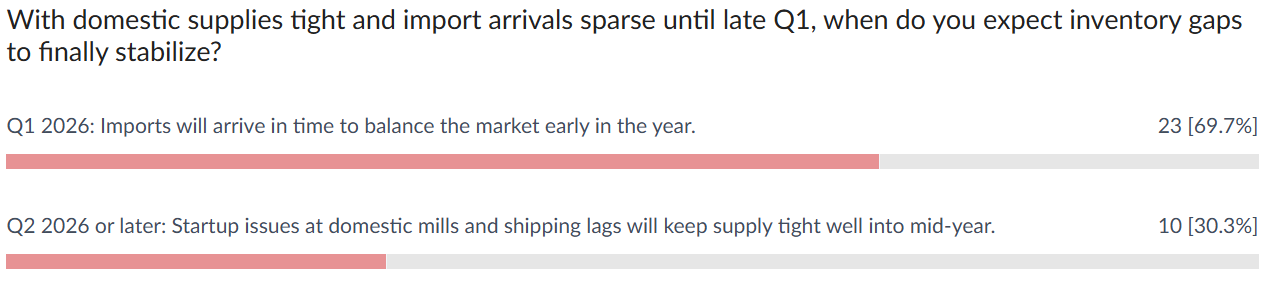 🏗️ StaalX Exhibits at World of Concrete 2026!Come see us at Booth #N3368 for a live demo of the digital steel marketplace that’s reshaping how the industry buys concrete reinforcements — including rebar, wire rod, welded mesh, and merchant bars. 🔥 Show-Only Bonus:
No strings attached. Just our way of saying thanks for visiting.  Explore the upgrades at www.staalx.com or get in touch today with websupport@staalx.com to see the difference.  🎙️ Missed Episode 13? Catch up now — we break down why U.S. construction data is sending mixed signals, as construction backlogs decline while confidence indicators rise heading into 2026. From falling backlogs among smaller contractors to improving sentiment driven by selective sector strength, Episode 13 explains how these conflicting trends are shaping steel demand, pricing pressure, and buyer decision-making going into early 2026. Listen now on ▶️ YouTube | 🎵 Spotify | 🎙 Apple Podcasts 👉 Follow the StaalX Construction & Steel Podcast for weekly insights on market shifts, freight trends, and sourcing strategies.  From our content partner, SteelOrbis .jpeg) US domestic rebar and wire rod prices flat week before the Christmas holiday Friday, 19 December 2025 18:13:39 (GMT+3) San Diego US domestic rebar and wire rod prices were flat this week, even as scrap price predictions for January were seen sideways to higher. “Domestic pricing should not change before the end of 2025. The market is slow now as people in the steel industry are taking a break before the new year,” said one long steel insider. In the weekly rebar spot markets, domestic supply on an FOB mill basis was assessed with most transactions noted at $46.00-47.00/cwt, ($920-940/nt or $1,014-1,036/mt), on average $46.50/cwt, ($930/nt or $1,025/mt), unchanged from seven days ago. “Some say [January] scrap is sideways while others think it is going to increase,” said a SteelOrbis insider. The anticipated January scrap and finished steel price increases, other insiders said, could depend on whether National Weather Service short-term forecasts for an increased amount of cold and snowy weather in the US Midwest and Northeast regions proves true early this winter. It could also depend, they say, on whether US mills, following a December scrap price increase, have any appetite left to take on the additional cost of higher January scrap given a normal seasonal drop in demand due to the approaching Christmas and New Years holidays. On the domestic long steel demand side, weekly discussions with market insiders again focused on the US construction industry and its current demand driver in new data center construction projects. While traditional residential and commercial construction activity remains tepid amid high interest rates, and unremarkable employment numbers, demand for rebar to build data centers continues to support spot pricing. On the supply side, on Nov. 7, Charlotte, North Carolina-based Nucor increased its posted prices for rebar by $30/nt ($33/mt), or $1.50/cwt. No additional rebar price increase announcements have been issued to date by the US steel maker. Insiders say supply remains tight with mills continuing to allocate available supply and to push back mill lead times to accommodate ongoing customer requirements. In the domestic wire rod market, domestic supply on an FOB mill basis was assessed with most transactions reported this week at $46.50-47.50/cwt ($930-950/nt or $1,025-1,047/mt), or an average of $47.00/cwt ($940/nt or $1,036/mt), unchanged from seven days ago. Wire rod pricing has stayed steady for several months now, amid reports of stable supply and slow demand. US import long steel pricing steady as higher US scrap is balanced by low seasonal demand Thursday, 18 December 2025 22:58:45 (GMT+3) San Diego US import long steel pricing remained stable this week in thin trade ahead of next week’s US Christmas holiday, market insiders told SteelOrbis. Higher December scrap prices, they said, appear to be balanced by lower seasonal demand for finished long steel products, keeping pricing steady versus week-ago levels. Long steel market insiders told SteelOrbis a seasonal lull in finished steel demand could limit further long steel price increases through the end of the year. Despite higher December scrap values, market insiders said US mills remain reluctant to increase long steel pricing more for fear of instigating an influx of new imports. Insiders added that continued slow US economic recovery is keeping domestic long steel demand “steady but limited,” even as tariff-reduced rebar and wire rod inventories continues to be an issue, especially on the US Gulf Coast. As previously reported by SteelOrbis, preliminary census data from the US Department of Commerce shows US imports of rebar totaled 36,016 metric tons in August this year, down 40.8 percent month on month and down 43.1 percent year on year. “The only interesting thing of note this week is that US scrap [for January]]continues to move higher,” said one US Midwest long steel importer. “Regardless of potentially higher scrap, long steel pricing is unlikely to move much higher through the end of the year.” This week, US Midwest scrap suppliers told SteelOrbis January scrap could increase $20-40/gt ($20-41/mt), though mill contacts said prices would more likely remain sideways to recent higher December settles. Shredded scrap closed December on average $20/gt higher at $385-390/gt ($391-396/mt). Despite rising scrap, the insider added that US steel demand could be lower than many originally thought, he said. “It’s kind of too early to tell whether the recent push to get data center builds completed to accommodate AI will continue in the new year. I’m expecting import long steel prices to remain fairly flat as we head into Q1.” On the US Gulf Coast, import rebar pricing on a loaded truck basis remains steady at $44.00-47.00/cwt., ($880-940/nt or $970-1,036/mt), or on average $45.50/cwt., delivered to customer, up from $44.00-46.00/cwt., ($880-920/nt or $970-1,014/mt) several weeks earlier. Reports continue to circulate about shrinking supply availability at US Gulf Coast and East Coast supply warehouses prompting sellers able to seek higher pricing, to do so for shrinking available spot supply. On the mill side, on Nov. 7, Charlotte, North Carolina-based Nucor increased its posted prices for rebar by $30/nt or $1.50/cwt., bringing spot prices to current levels. Insiders said as supplies remain tight as a result of tariffs, the Nucor price increase has been fully accepted by the market. No further posted rebar price increases have been announced by the mill since that date. Insiders say a domestic rebar price approaching $47.00-48.00/cwt., ($940-960/nt or $1,036-1,058/mt), might encourage an “influx” of new rebar imports into the US Gulf Coast and US East Coast markets. Current domestic rebar spot pricing remained steady for a fourth week at $46.00-47.00/cwt., ($920-940/nt or $1,014-1,036/mt), just short though very near the stated import price threshold. Long steel market insiders said ongoing 50 percent Section 232 steel tariffs would limit 4 th quarter imports to a mere 50 thousand tons. Q1 imports, they said, are likely to rise as domestic inventories continue to dwindle and import pricing becomes more competitive with its domestic supply counterparts. On the US East Coast, import rebar on a loaded truck basis was assessed flat versus week-ago levels at $44.00-47.00/cwt., ($880-940/nt or $970-1,036/mt), continuing at parity with US Gulf Coast pricing. On the import wire mesh front, US Gulf Coast import pricing for wire rod mesh on a DDP loaded truck basis remained steady for yet another week at $42.00-43.00/cwt., ($840-860/nt or $926-948/mt). Traders told SteelOrbis importers could make additional inroads into the US engineered wire mesh market as Nucor announced another $40/ton ($2.00/cwt.) increase this past week. At last report, it remained unclear whether US spot market will accommodate the higher price offers on engineered wire mesh this week from Nucor, though continued supply tightness in local markets could see more market acceptance of the increase following the holidays, especially if January scrap trades higher, insiders said. January US scrap seen sideways to $40/gt higher following recent December market gains Thursday, 18 December 2025 18:59:18 (GMT+3) San Diego January scrap in the US is seen continuing the recent steady to upward price trend following last week’s December buy-cycle settles which saw prices up $10-20/gt over all domestic ferrous scrap grades, market insiders told SteelOrbis this week. During recent December monthly scrap supply negotiations, December scrap pricing rose amid reports that supplier inventories were more limited than prior months because inflows dropped as a result of recent cold and snowy weather in the US Midwest, even as US mills purchased more scrap in December as steel production facilities returned to operation following the completion of annual maintenance operations. Improved export scrap sales also boosted requirements for US East Coast supplies, they said. “I heard plus $20/gt to plus $40/gt from two mills, but it’s kinda too early to tell,” remarked one US East Coast scrap insider. “Demand is slowing due to seasonality.” Direct SteelOrbis conversations with domestic mill scrap buyers found the majority think pricing for January will be sideways. “Mills will stand firm at sideways come January I suspect,” said another Midwest scrap insider. “While dealers will continue to try to ride December’s ‘up train’ on pricing into January.” “We’re hearing very little new on January scrap,” remarked another Midwest scrap dealer this week. “The expectation, however, is that it will be up, though.” Similar to one week ago, based on an average $30/gt January increase in Midwest shredded scrap pricing, the grade is seen settling as high as $415-420/gt ($421-425/mt) delivered to mill, while busheling scrap which gained $10/gt during December negotiations, could settle near $425-435/gt ($431-441/mt) if higher expectations prove true. In Ohio Valley HMS and P&S grades, a $30 average January price increase could net settles at $365-385/gt ($370-390/mt), and $401-411/gt ($407-4317/mt), respectively, on a delivered to mill basis. In the US Northeast, scrap insiders said a continuation of increased export demand could boost January scrap values as importers buy an increased amount of US supply towards their higher February scrap requirements. January shredded grades are seen potentially up on average $30/gt on a delivered to mill basis from $10/gt higher December settles at $365-375/gt ($371-381/mt), while busheling scrap could settle on average $30/gt higher at $380-400/gt ($385-405/mt). For cut grades, a $30 increase would net January settles near $345-360/gt ($351-365/mt), for HMS I/II, while P&S scrap could settle $30 higher near $330-340/gt ($335-345/mt). “I’m hearing about $30/gt higher for January scrap,” said a final SteelOrbis scrap insider. “I’m also hearing that finished products will be up $40/nt for January. That’s the latest buzz.” Much of the anticipated January scrap and finished steel price increases, insiders said, could depend on whether National Weather Service short-term forecasts for an increased amount of cold and snowy weather in the US Midwest and Northeast regions proves true early this winter, and whether US mills, following a December scrap price increase, have much of an appetite left to absorb the additional cost of higher January scrap given a normal seasonal drop in demand with the Christmas and New Years holidays coming soon. Additional steel production price increases, they say, could net additional finished steel price increases that might encourage a further influx of imports. Do you have any questions? Check out our FAQ!Check out the most frequently asked questions about the service and products of StaalX. We are always here to chat with you in the chat boxes from the site or on the support telephone number below. Contact us websupport@staalx.com or +1 (708) 697-3227 Follow StaalX on |







Need steel? Get an instant quote & save $500 off your first order
Search rebar, wire rod, wire mesh and more on StaalX. Check availability and book reliable delivery nationwide.