| | | |
Will Other Products Follow?
|
|
There's a fascinating pricing dynamic happening in the U.S. steel market right now. Even within the same product categories, such as rebar and wire rod, or merchant bars and beams, prices have been trending in different directions.
A strange divergence is taking place between long products and flat-rolled products. Since the Section 232 tariffs were increased to 50% in June, rebar has been the most bullish product. Prices have surged by more than $120/ton, and the rally might not be over. Rebar mills are now struggling to keep up with new orders and are delaying some shipments, even in a somewhat modest demand environment. Buyers are concerned that if all the delayed construction projects get greenlit at once, it could create a significant supply shortage.
This places fabricators in a difficult position. They have to fulfill their backlogs in a rapidly rising price climate. This will squeeze their margins, and even if they can pass on the cost increases, contractors will not be happy.
What's Happening with Other Steel Products?
The buying frenzy for wire rod has now subsided, and there is no longer a noticeable shortage. Buyers still want import options despite the 50% tariffs, but they don't need new steel until the first quarter. While some of the inflated market prices have retracted, mills have settled at a comfortably profitable price level.
Beams have remained strong, but merchant bars have been quite soft. Domestic producers have only managed a modest price increase since June, and the price difference between beams and merchant bars remains significant.
The biggest mystery of all is the flat-rolled market. Prices have been steadily declining since June, dropping by about $40/ton in total. The sentiment remains bearish, even for products that are in short supply, like tinplate, tin-free steel, and thin-gauge coated products. Some attribute the soft prices to the newly added domestic capacity, but this doesn't explain the situation for all flat-rolled products.
Looking Ahead
Overall economic data doesn't point to a major slowdown in the economy or construction activity. It suggests that the flat-rolled market should be performing better than it currently is. The slow demand may be a result of built-up inventories. However, as September approaches, buyers may need to replenish their stock. With import options limited, this pent-up demand could cause prices to pop faster than people currently anticipate.
|
| |
Payment Terms with StaalX
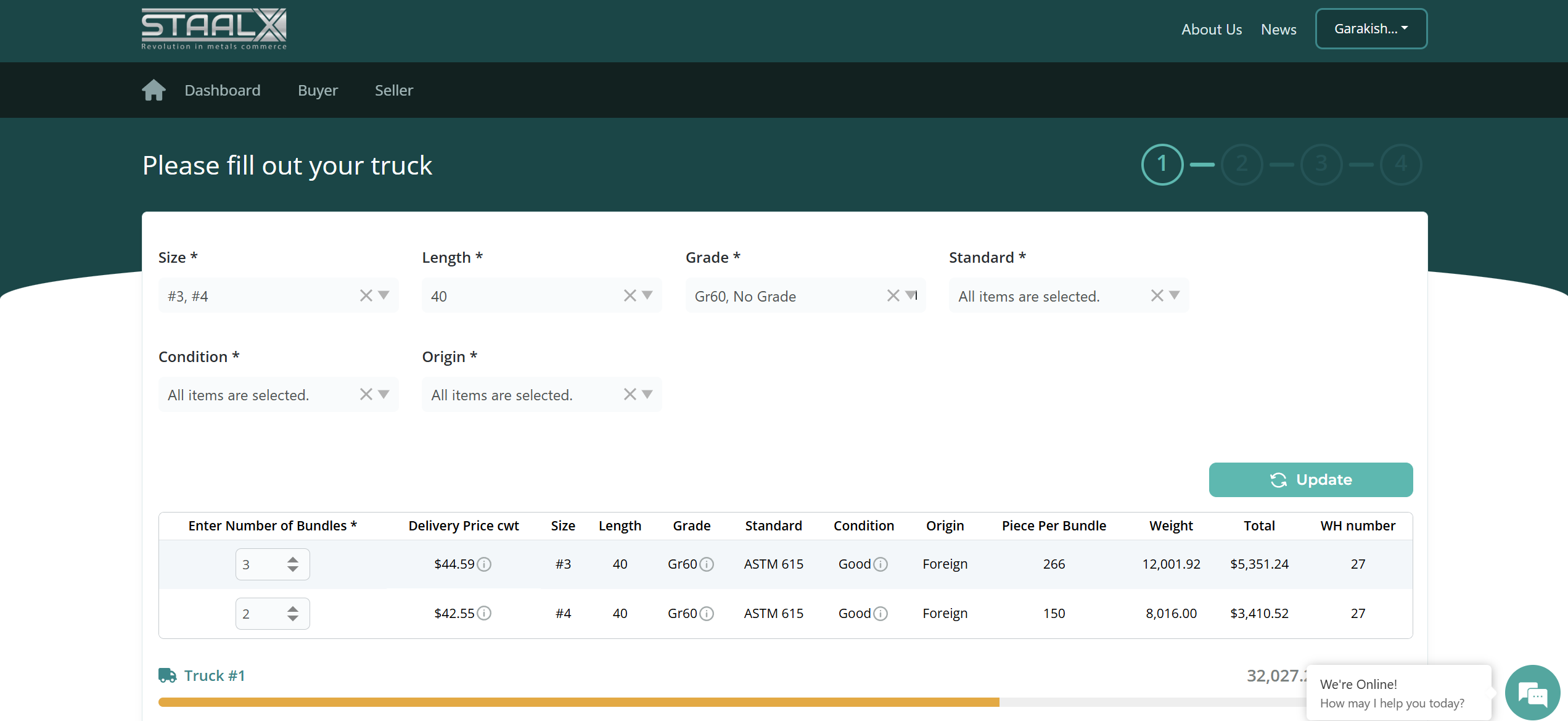
StaalX has transformed the way companies and contractors buy steel—making it possible to browse, get an instant quote, purchase and finance steel products for a truck load or less, entirely online. From the beginning, StaalX's goal has been to make wholesale quantities of steel buying as easy and as seamless as any other online purchase. |
|
|
|
There's a fascinating pricing dynamic happening in the U.S. steel market right now. Even within the same product categories, such as rebar and wire rod, or merchant bars and beams, prices have been trending in different directions.
A strange divergence is taking place between long products and flat-rolled products. Since the Section 232 tariffs were increased to 50% in June, rebar has been the most bullish product. Prices have surged by more than $120/ton, and the rally might not be over. Rebar mills are now struggling to keep up with new orders and are delaying some shipments, even in a somewhat modest demand environment. Buyers are concerned that if all the delayed construction projects get greenlit at once, it could create a significant supply shortage.
This places fabricators in a difficult position. They have to fulfill their backlogs in a rapidly rising price climate. This will squeeze their margins, and even if they can pass on the cost increases, contractors will not be happy.
What's Happening with Other Steel Products?
The buying frenzy for wire rod has now subsided, and there is no longer a noticeable shortage. Buyers still want import options despite the 50% tariffs, but they don't need new steel until the first quarter. While some of the inflated market prices have retracted, mills have settled at a comfortably profitable price level.
Beams have remained strong, but merchant bars have been quite soft. Domestic producers have only managed a modest price increase since June, and the price difference between beams and merchant bars remains significant.
The biggest mystery of all is the flat-rolled market. Prices have been steadily declining since June, dropping by about $40/ton in total. The sentiment remains bearish, even for products that are in short supply, like tinplate, tin-free steel, and thin-gauge coated products. Some attribute the soft prices to the newly added domestic capacity, but this doesn't explain the situation for all flat-rolled products.
Looking Ahead
Overall economic data doesn't point to a major slowdown in the economy or construction activity. It suggests that the flat-rolled market should be performing better than it currently is. The slow demand may be a result of built-up inventories. However, as September approaches, buyers may need to replenish their stock. With import options limited, this pent-up demand could cause prices to pop faster than people currently anticipate.
|
|
That means removing friction at every step, from getting a quote, delivering and financing the purchase of our customers.
As pioneers in steel ecommerce, the StaalX team is committed to making every part of the steel purchasing experience easier for our buyers. This includes adopting innovative payment solutions.
With our secure checkout, our buyers don’t have to get out their checkbooks. They sign in with the same bank username and password they use every day, connect their bank to StaalX and make their payment automatically in 30 days after purchase for Net 30 days payment terms.
StaalX's "Pay Later" fee is 1% for Net 30 days payments. Next, we will roll out Net 60, Net 90 days payments, and other creative Pay Later options as part of our mission to provide value to both buyers and sellers by making transactions simpler through innovative technologies.
Stay tuned. See you at StaalX.com!
Warmly,
Murat Askin Founder and CEO
|
| | | | | | 💡 Still Buying Steel the Old Way? |
| You Deserve Better.
Chasing quotes. Endless calls. Missed deliveries.
That’s the old way of sourcing steel.
StaalX makes it simple: ✅ Real-time pricing – no waiting
✅ Transparent freight + lead times
✅ One-stop checkout — like Amazon, but for steel
✅ Smart tools built for buyers & fabricators
🔗 Try It Now on www.staalx.com
📦 Whether you buy rebar, mesh, or wire rod — we’ve got you covered. |
| | | | | From our content partner, SteelOrbis
|
| | US import rebar and wire rod pricing resumes upward trend on continuing supply issues Thursday, 21 August 2025 19:09:11 (GMT+3) San Diego US import rebar and wire rod pricing resumed upward movement this week, fueled by reports that record low finished steel imports continue to reduce available supply, market insiders told SteelOrbis. The combination of ongoing 50 percent steel import tariffs and the enhanced importer risk associated with ongoing anti-dumping cases currently under review by the US Department of Commerce (DOC), continues to limit the amount of material available, they said.
“There’s very limited sources of supply available to the market right now,” remarked one US Gulf Coast importer. “Record low imports are likely to continue over the next 6 months or so, as additional anti-dumping cases get settled.”
On August 12, media reports indicate a preliminary anti-dumping margin of 18.87 percent was assigned for Colakoglu Metalurji A.S and Colakoglu Dis Ticaret A.S. of Turkey, with the DOC finding they sold rebar at less than fair value during the period of July 1, 2023 through June 30, 2024. The final results of the investigation are expected within 120 days. The previous AD rate for the company stood at 1.13 percent, while the minimal rates for other Turkish mills were at 1.02 to 3.9 percent and up to 25.83 percent as highest.
“Colakoglu-Metrade has material on the ground but they are running out of sizes and also not quoting due to high (anti dumping duties),” a second import insider told SteelOrbis. “They have a ship coming into Houston in October, but that’s all I’ve heard.”
This week, import rebar on a loaded truck basis on the US Gulf Coast is discussed at $43-44/cwt., ($860-880/nt or $948-970/mt), or on average $43.50/cwt., up from $41.00-43.00/cwt., ($820-860/nt or $904-948/mt), one week prior. On the US East Coast, import rebar gained a bit less, insiders said, settling the week about $1.00/cwt., higher at $43.00-46.00/cwt., ($860-920/nt or $948-1,014/mt) amid continued reports suppliers are seeing reductions on some sizes of rebar product as imports wane and domestic mills struggle to fill a growing supply gap.
Insiders say as ongoing AD cases and tariffs continue to cloud the near to midterm supply outlook, importers are “looking at future supplies from Oman, UAE, as well as Turkey.” They added that some of their colleagues are surprised that the outlook for September scrap in the US is not “through the roof” as a result of continued low imports.
At last report, US local scrap contacts are calling September scrap sideways to potentially down next month as demand for scrap is expected to be reduced starting in September as many US mills begin yearly scheduled maintenance operations that last through December. Some insiders caution reduced import flexibility could make current import long steel markets more susceptible to price spikes, especially if domestic demand improves.
“Order intake increases at US mills should see stronger scrap prices, but we’re not seeing that,” remarked the SteelOrbis insider. “What I see on the long steel import side is that domestic rebar seems to be a little tighter and that mills are busier,” he said. “With the tariffs in place what it means for importers is that barely any trades are getting done. With any kind of unexpected demand increase, things could get really interesting, especially if US mills start to lag behind in their deliveries. As it stands now, importers are basically waiting for US prices to rise, so as to enable imports to resume with the current 50 percent tariffs in place.”
As supplies continue to tighten, insiders told SteelOrbis that reports are beginning to circulate in steel trading circles about the strong possibility of another rebar price increase of about $40/nt ($44/mt), or $2.00/cwt., from US mills toward the end of August. And, while not representative of the majority of weekly trade, insiders reported to SteelOrbis that Nucor sold small single truckloads of domestic rebar as high as $46.50/cwt.
On the tariff front, importers expressed concern that this week’s announcement from the US Trump administration that steel derivative products, including electrical steel lamination and cores, as well as certain stainless steel automotive exhaust parts, would be added to products subject to 50 percent Section 232 tariffs, could further reduce already low import activity.
“From an importers’ standpoint, there’s just too much risk right now given what’s going on with Section 232 tariffs and ongoing AD cases,” he said. “Personally, I remain very hesitant to assume that level of risk.”
In the Mexican long steel markets, while 50 percent tariffs remain in place, pre-tariff rebar available vicinity Houston, Texas, on a loaded truck basis is discussed little changed at $40-42/cwt., ($800-840/nt or $937/mt to $959/mt), compared with earlier weekly estimates at $40-43/cwt., insiders said. As Mexico continues to deal with high export tariffs to the US, one Mexican trader told SteelOrbis that their direct sales of long steel to Canada via ship and rail have increase four-fold, helping to support recent price stability in the North Region in the face of unremarkable local demand.
In the imported wire rod markets, spot pricing gained a bit this week with wire rod mesh on a DDP loaded truck USGC basis reported about $0.50/cwt., higher at $42.50-43.50/cwt., ($850-870/nt or $937-959/mt), up from $42.00-43.00/cwt., ($840-860/nt or $926-948/mt), against stable ex-mill delivered domestic Midwest supply pricing reports at $46.50-$47.50/cwt., ($930-950/nt or $1,025-1,047/mt).
“We’re hearing reports of tight wire rod supply and rising freight rates on shipping,” said the SteelOrbis insider. “So basically, with a lack of shipments, buyers have less options, because there is less competition among shippers.”
US domestic rebar and wire rod both flat for the fourth consecutive week Friday, 22 August 2025 00:20:33 (GMT+3) San Diego US domestic rebar and wire rod remain flat this week as scrap stays sideways as we get closer to September. Many have described this stable market as a “summer slump” or “the summer doldrums". Domestic demand is still driven by a strong construction sector and infrastructure spending.
In the weekly rebar spot markets, domestic supply on an FOB mill basis was assessed with most transactions noted at $43.50-44.50/cwt, ($870-890/nt or $959-981/mt), on average $44.00/cwt, ($880/nt or $970/mt), unchanged from seven days ago. “Despite the flat pricing over the last few weeks, rebar is trending up,” according to a SteelOrbis insider. Overall, taking into account the diminishing import volumes due to the valid minimum 50 percent restrictions, many expect that the domestic rebar prices might strengthen in the future, but for now they are held back by the sideways scrap and seasonally limited trade.
In the domestic wire rod market, domestic supply on an FOB mill basis was assessed with most transactions reported this week at $46.50-47.50/cwt ($930-950/nt or $1,025-1,047/mt), or an average of $47.00/cwt ($940/nt or $1,036/mt), unchanged from seven days ago. "Wire rod is trending neutral,” the SteelOrbis insider continued.
September US scrap seen sideways to down on declining flat steel, August scrap overhang Thursday, 21 August 2025 23:11:42 (GMT+3) San Diego The weekly US scrap price outlook for September was unchanged this week at sideways to potentially lower as a result of continued declines in flat steel pricing as well as new reports that a prime scrap “overhang” continues to exist due to the paucity of August trade, market insiders told SteelOrbis.
Insiders said mills didn’t buy the prime scrap that local scrap suppliers had expected them to purchase during the August buy-cycle because 50 percent tariffs on Brazilian pig iron threatened by US President Trump didn’t happen.
“Primes didn’t go down in August, though if the (supply) overhang persists in September, I suspect that prime scrap could decline,” the Midwest scrap insider told SteelOrbis. “I think September is looking sideways to down depending on grade,” he added. “Primes seemed to have overhang that could potentially push prices down in September some, while cuts seem to remain tight but sideways. Shred is looking sideways to down, as it could get dragged down by primes.”
Insiders added that mill closures for annual maintenance -that typically start in September and end in December- could also reduce mill scrap purchases during the September and October buy cycles.
“I think mill closures across September, October and November will create significant downward pressure on pricing during the September and October buys,” the insider added. “Especially with the bearish export market and the softness in hot-rolled coil pricing.”
This week, flat steel pricing is reported $5-10/nt less at $820-$830/nt ($904-915/mt), or on average $41.25/cwt. Flat steel insiders said scant mid-month demand and a growing outlook for sideways to lower September scrap is limiting upward price movement. SteelOrbis historical data shows flat steel pricing has declined consistently since the end of June as scrap demand has remained unremarkable with sideways pricing reported for three straight months.
Based on a sideways to down from August, September settlement, US Midwest prime busheling scrap in the Ohio Valley could settle at or below $435-460/gt ($443-468/mt), while shredded scrap might settle at or below $375-380/gt ($381-387/mt). Ohio Valley P&S and HMS grades are seen at or below $361-371/gt ($367-377/mt) and $325-345/gt ($330-387/mt), respectively, scrap insiders told SteelOrbis.
In the US Northeast, a sideways to potentially lower September scrap settle would put prime busheling grade material at or below $380-400/gt ($387-407/mt), while shredded grades could settle at or below $325-335/gt ($330-342/mt). P&S and HMS grades might finish at or below $295-305/gt ($300-310/mt) and 305-320/gt ($310-325/mt), respectively, scrap insiders told SteelOrbis this week.
SteelOrbis historical scrap data shows since monthly domestic scrap prices peaked in March ahead of much anticipated tariff announcements from the US Trump administration, the average price of Midwest Ohio Valley shredded scrap has slumped more than 24 percent from on average $506/gt ($514/mt) to $384/gt ($390/mt). HMS pricing in the US Northeast dropped a more conservative 22.8 percent during the equivalent period to on average $313/gt ($318/mt) amid somewhat limited export demand for US scrap.
|
| |
Do you have any questions? Check out our FAQ! |
| Check out the most frequently asked questions about the service and products of StaalX. We are always here to chat with you in the chat boxes from the site or on the support telephone number below.
|
| | | Contact us websupport@staalx.com or +1 (708) 697-3227
Follow StaalX on
|
| |
|
| |


-article_image.jpg&w=1920&q=75)