US import long steel steady to up on reduced supply, importers fear high replacement costs
Thursday, 07 August 2025 20:33:26 (GMT+3) San Diego
US import long steel prices were steady to higher this week as current steel tariffs and ongoing investigations by the US Commerce Department stand to further reduced available supply, fueling fears among steel importers that their near-term product replacement costs could be sharply higher, market insiders told SteelOrbis.
As of June 4, with the exception of the UK, all nations importing steel and aluminum into the US have to pay doubled 50 percent tariffs, making most deliveries non-competitive against domestic suppliers, unless domestic prices were to increase substantially. And so far, US mills have remained “fairly conservative in raising prices,” insiders said.
Importers told SteelOrbis stocks of pre-tariff steel shipped to the US and stored on US Gulf Coast docks before tariffs went into effect, have been steadily drawn down, fueling increasing fears among importers that many will face the added risk of starkly higher replacement costs in the near future.
“On rebar we have seen the upriver market (Chicago) up by about $1.00/cwt.($20/nt or $22/mt) this week versus last week because basically there is very little import material available at the moment,” said one Gulf Coast long steel import insider. “A number of barges have been canceled, and some suppliers are running out of certain sizes of steel, which prompts prices to move higher.”
Importers add that the June 25 anti-dumping and countervailing duty (AD/CVD) investigations being conducted by the US Department of Commerce against large rebar exporters from Egypt, Bulgaria, Vietnam, and Algeria are having an effect on the market. “With the ongoing investigations, traders have become more hesitant to book future cargoes,” he said.
Insiders say the combination of tariffs and ongoing AD/CVD investigations continues to embolden domestic suppliers to raise prices, even as US demand from the construction industry continues to lag and continued high interest rates do little to spur much needed domestic infrastructure investment that would increase rebar and wire rod demand.
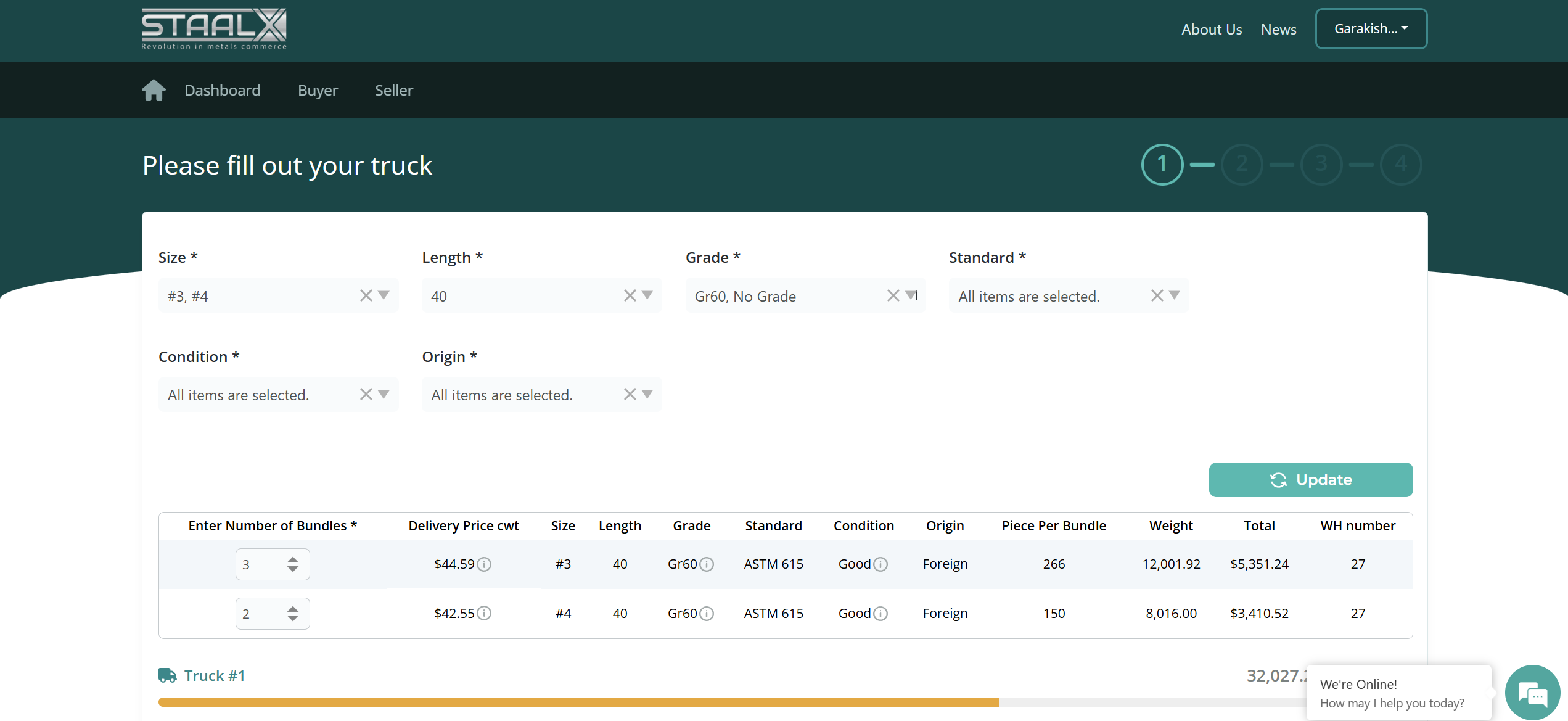
In the weekly import rebar markets, insiders report transactions done on a US Gulf Coast loaded truck basis in the $41.00-43.00/cwt., range ($820-860/nt or $904-948/mt), up from on average $41.00/cwt., ($820/nt or $904/mt) one week earlier.
Insiders report to SteelOrbis that new deliveries in the $43.00/cwt. FOB Houston range, “with a bunch of stipulations,” presumably from Turkey via the Red Sea, are “not that attractive, though importers have to make a living and try to compete against domestic supply.”
In the import wire rod markets, insiders say domestic suppliers continue to garner most new sales with import prices on a DDP loaded truck basis USG reported steady at $42.00-43.00/cwt., ($840-860/nt or $926-948/mt), against stable ex-mill delivered domestic Midwest supply pricing reported at $46.50-$47.50/cwt., ($930-950/nt or $1,025-1,047/mt).
“Imports remain slow,” commented another Gulf Coast long steel insider. “People are hesitant to sell with the new tariffs because inventories are down,” he said. “People remain concerned about selling steel because their replacement costs are going to be higher. US mills have a real opportunity right now based on how much capacity they can bring online.”
The insider added that most US domestic rebar mills are currently averaging about 75 percent of their rated capacity “plus or minus 8 percent,” he said, and that most cannot produce more than 88 percent capacity because they need to produce multiple sizes of different items for the market.
“It seems right now there is enough capacity out there domestically, it's just a matter of whether US mills can produce enough steel to make up for the lack of imports,” he added.
On the production side, the insider said that current domestic mill lead times for new rebar domestic production have been “pushed out” over the past two months by 1-2 weeks since tariffs were announced to about 6-8 weeks.
“The lack of imports has given US mills more leverage in the market,” he said. “As a result, there are shortages out there, especially in wire rods, becausenobody really knows how the Liberty situation will play out.”
Dallas, Texas-based Liberty Steel & Wire Co., is currently applying to the Illinois Department of Commerce and Economic Opportunity for a $25 million grant that would “complement existing tax credits and some private funds,” according to media reports. The company also plans to invest about $70 million to expand operations and hire an additional 700 full-time workers in Peoria, Illinois, where its new headquarters would be located according to the latest plan.
US domestic rebar and wire rod both flat for the second consecutive week
Thursday, 07 August 2025 22:29:42 (GMT+3) San Diego
US domestic rebar and wire rod are both flat this week as scrap is reported to be strong sideways this month. “We are heading for a big slow down for the steel market with all of the uncertainty and tarrifs,” said a SteelOrbis insider. While the availability if the import rebar and wire rod at the US warehouses has been shrinking and hardly any new import deals have been closed after the 50 percent tariff was introduced, the domestic demand still does not seem strong enough to urge the mills to increase their prices.
In the weekly rebar spot markets, domestic supply on an FOB mill basis was assessed with most transactions noted at $43.50-44.50/cwt, ($870-890/nt or $959-981/mt), on average $44.00/cwt, ($880/nt or $970/mt), unchanged from seven days ago.
In the domestic wire rod market, domestic supply on an FOB mill basis was assessed with most transactions reported this week at $46.50-47.50/cwt ($930-950/nt or $1,025-1,047/mt), or an average of $47.00/cwt ($940/nt or $1,036/mt), unchanged from seven days ago.